

If you’re eyeing the Canon C50 for underwater cinematography, the big question is which Canon C50 underwater housing will give you the most reliable, flexible rig when the housings drop. The C50’s 7K Open Gate image and compact RF-mount body make it an exciting platform, but no internal NDs, no EVF, and no SDI change the housing calculus. Based on each brand’s track record, a Nauticam Canon C50 underwater housing will likely lead on pro ergonomics, HDMI monitor integration, and expansion, while an Ikelite Canon C50 underwater housing should deliver a lighter, more affordable path that’s easier to travel with. Choosing the best underwater camera housing for your workflow comes down to the balance of budget, monitor needs, and lens/port plans. Either way, the Canon C50 cinema camera looks set to become one of the most compelling bases for a canon underwater camera housing this year.
Below is a basic comparison of what you can expect from Nauticam and Ikelite Underwater housings:
| Decision point | Nauticam Canon C50 underwater housing | Ikelite Canon C50 underwater housing |
|---|---|---|
| Status | Not yet announced (track record suggests likely) | Confirmed intent; timeline TBD |
| Depth rating | Commonly 100 m / 330 ft on comparable Nikon Z housings | 60 m / 200 ft on 200DL line |
| Build | Hard-anodized aluminum; pro-rig feel | Polycarbonate/ABS blend; lighter, travel-friendly |
| Ergonomics | Excellent lever placement; integrated handles | Clear back for visual checks; modular grips |
| I/O & monitoring | Broad bulkhead options; external monitor housings available | Fewer high-bandwidth options; simpler, lower cost |
| Vacuum/leak check | Integrated electronic vacuum systems common | Vacuum valve options available |
| Typical price | Higher (premium ecosystem) | Lower (budget-friendlier entry) |
Canon C50 UNDERWATER HOUSING OPTIONS:
Ikelite Canon C50 Underwater Housing
*A lightweight yet durable, budget-friendly option*
The Ikelite Canon C50 200DL is meticulously designed to provide full access to all essential camera controls and functions of the Nikon ZR. This seamless integration allows videographers to adjust settings effortlessly, ensuring no moment is missed. The housing's ergonomic design places controls within comfortable reach, even when wearing diving gloves, enhancing the overall shooting experience.
Based on field tests done with other Ikelite underwater housings, we always find the housings to be intuitive and reliable for both stills and video work. The housing’s lightweight polycarbonate build made a big difference during longer dives—it was easy to maneuver without feeling flimsy. The control levers are large and responsive, giving the user full access to the camera's key settings, even while wearing thick gloves in cooler water.
We await further details from Ikelite before we can expand on the housing specifications.
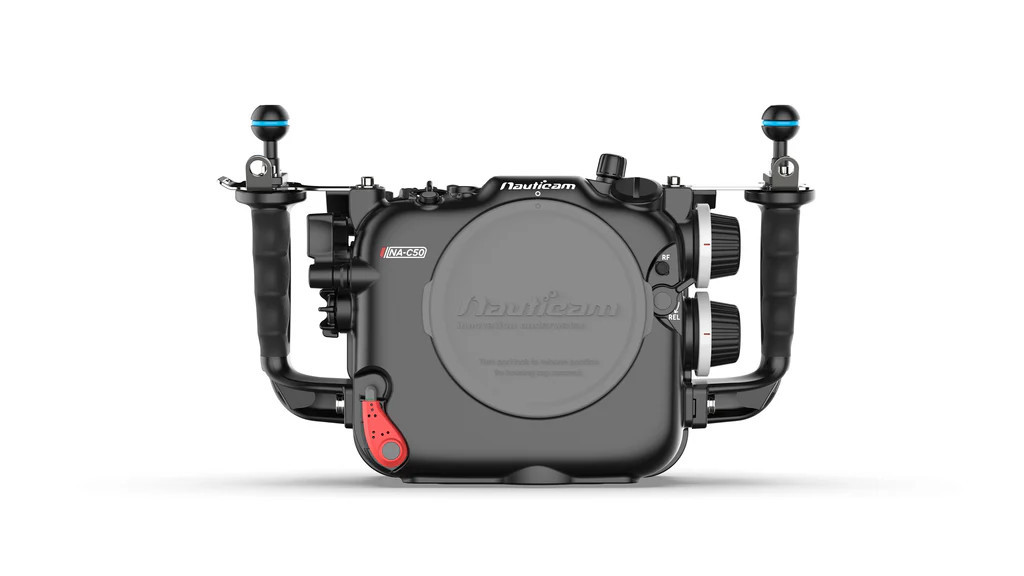
Nauticam NA-C50 Underwater Housing
*Precision engineered, Excellent Ergonomics, and Innovative*
The NA-C50 housing is built like a tank. Machined from a solid block of aluminum and hard-anodized for maximum durability, it’s more than ready for the most demanding saltwater conditions. With marine-grade stainless steel and precision-molded high-strength plastic components, this housing doesn’t just feel premium—it performs like professional gear should.
The Nauticam NA-C50 is a purpose-built underwater housing designed for the Canon EOS C50 cinema camera, combining professional cine-capabilities with robust underwater engineering. Constructed from hard-anodized aluminum, it’s rated to a depth of 100 m and features the N120 port system for versatility with RF and EF lenses. Key design elements include ergonomic dual handles, a built-in vacuum-check and leak-detection system, internal space for a USB-C power bank, and support for HDMI 2.0 via an M24 bulkhead—making it well suited for serious underwater filmmakers working wide-angle, macro, or extended production dives.
Pros
- High build quality and professional control layout make it ideal for serious underwater video work.
- Versatile port system supports a wide array of optics (wide-angle, macro, super-macro) via Nauticam’s ecosystem.
- Robust depth rating and safety features (vacuum check) give greater confidence for demanding dives.
- Internal power bank support means longer run times without adding bulky external battery trays.
Cons
- Premium pricing (approx. US $5,900) means a significant investment for the housing alone.
- Designed exclusively for the Canon EOS C50; not compatible with other camera bodies, limiting flexibility.
- As with all pro rigs, overall system size and buoyancy depend heavily on choice of ports, wet lenses, lights and monitors — could require additional rigging to balance underwater.
Canon C50 Mirrorless Camera

Canon’s new EOS C50 drops a brand-new 7K full-frame sensor into the smallest, lightest Cinema EOS body yet, pairing internal 12-bit Cinema RAW Light with oversampled 4K up to 120p and even a 32MP stills mode that shoots to 40 fps. It’s RF-mount, actively cooled, and designed around a detachable top handle that adds 2x full-size XLRs—so you can run lean for gimbal/underwater or build it up for doc and commercial days.
On the I/O side you get full-size HDMI (Type-A), timecode, USB-C, mic/headphone jacks, Wi-Fi/Ethernet control (via adapter), plus the multi-function shoe; recording goes to CFexpress Type-B (main) with an SD UHS-II slot for proxies or simultaneous capture—even landscape and vertical files at once.
A few realities to know up front: there’s no internal ND, no SDI, no EVF, and no sensor-shift IBIS. You do get Canon’s Combination IS (optical + digital) if your lens supports it. Practically, that nudges rigs toward external ND solutions and HDMI monitor/recorder workflows—still very manageable given the body’s size and power draw.
After testing in field for a few shoot days, what stood out first was flexibility. Open Gate gives room to punch out 2.39 or vertical social cuts without a reshoot, and for action work it was found that 7K 16:9 up to 60p or 4K120 worked best - both look cleaner than expected at this price. The trade-offs are straightforward: drop-in NDs have to be used with the RF adaptor, and a compact HDMI monitor needs to be purchased separately since there’s no EVF. Dual-base ISO 800/6400 is legitimately useful; 6400 is cleaner than anticipated for quick interiors. Battery-wise, the C50 seems to be heavy, so spares are needed.
Key Specifications the Canon C50 Mirrorless Camera
7K full-frame CMOS sensor with 12-bit Cinema RAW Light (HQ/ST/LT) internal recording.
Frame rates: 7K 16:9 up to 60p, 7K 3:2 Open Gate up to 30p, 4K up to 120p, 2K up to 180p.
Dual Pixel CMOS AF II with EOS iTR AF X subject detection and tracking.
Dual Base ISO 800/6400, 15+ stops DR (FF), 16 stops (S35).
RF mount with support for EF/PL via adapters (Cooke /i with PL-RF).
Two card slots: CFexpress Type-B (main) + SD UHS-II (proxies/simul).
Connectivity: HDMI Type-A, timecode, USB-C, mic/headphone; 2x XLRs on the detachable handle.
32MP stills mode up to 40 fps (electronic shutter).
Active cooling for long takes; Combination IS (optical + digital) (no sensor IBIS).
No internal ND / no SDI / no EVF—plan for external ND and an HDMI monitor.
Next Steps After Picking Your Housing:
Why Trust Bluewater Photo?
Our team includes professional underwater photographers and videographers with over 15 years of experience testing and photographing underwater to ensure you get thorough first hand experience and trusted reviews.
Expertise in Underwater Photography: Run by passionate divers and photographers who truly understand the gear and how it performs in real-world conditions.
Competitive Pricing: Offers competitive prices with added value like expert advice and top-tier customer support. We will match and beat any price!
Established Reputation: Trusted by thousands of divers, photographers, and professionals worldwide.
Exceptional Customer Support: Personalized service from knowledgeable staff who care about getting you the right gear.
Transparent and Honest Advice: Recommendations are based on what’s best for your needs—not just what’s in stock.
More about the Expert


Anthony Grote
Anthony Grote is a South African-based professional photographer, widely recognized for his work in underwater, wildlife, adventure sports, and hospitality photography. His passion for the craft began in the early 1990s during his studies, where he initially focused on bird photography.
As his interest expanded into underwater photography, Anthony moved to the Cayman Islands, where he spent two years working as an underwater photo pro. He later returned to South Africa to establish his own photography business, specializing primarily in adventure sports and the hospitality industry.
Over the years, Anthony has received numerous accolades for his underwater and wildlife imagery. His work has also included contributions to the National Geographic production The Real Serengeti, filmed in the iconic Serengeti wilderness.
Today, Anthony continues to travel the globe, diving and documenting nature whenever possible. He currently serves as the Website Manager for Bluewater Photo, while still pursuing adventure sports photography in his spare time.