

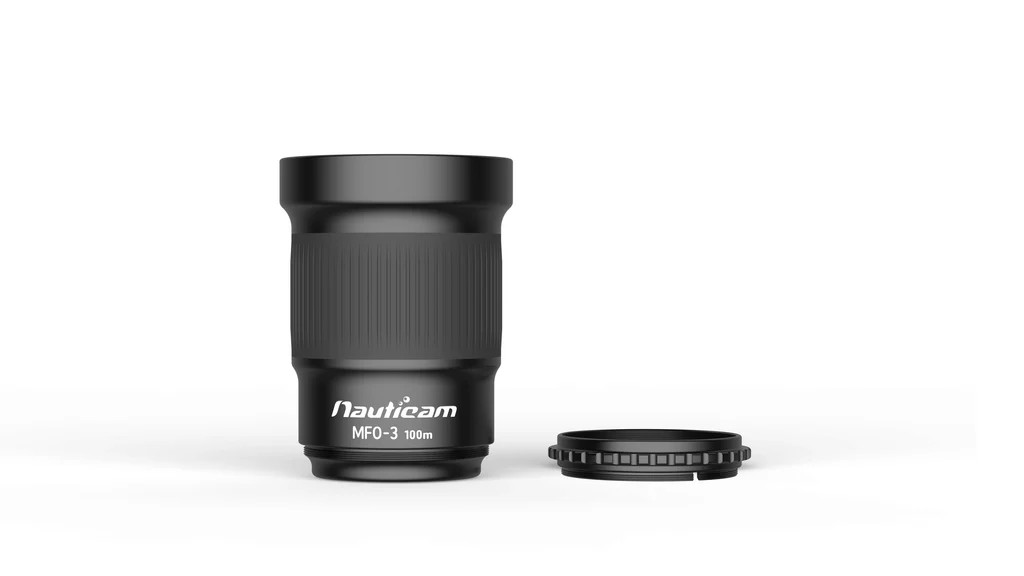
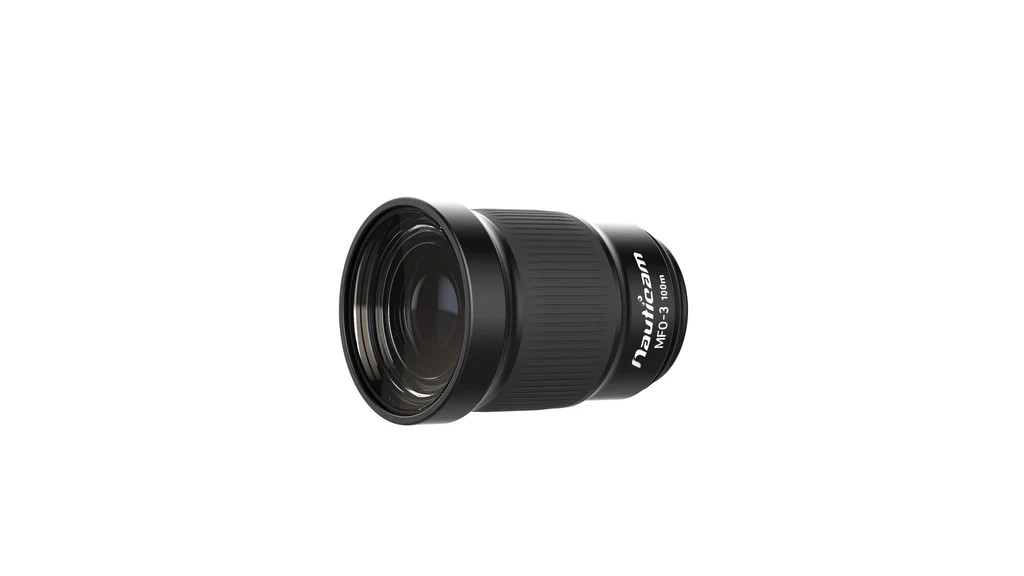
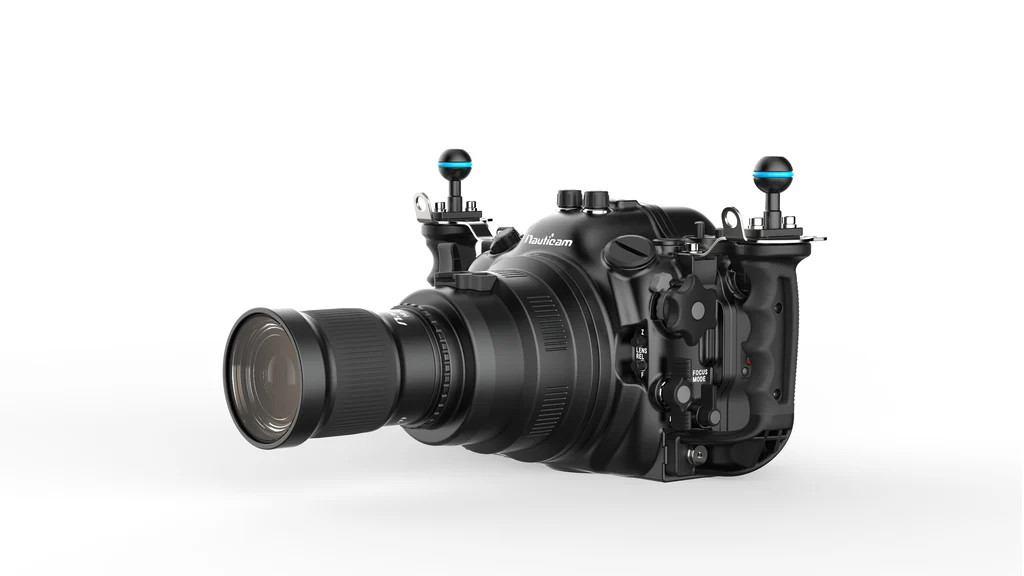


What the Nauticam MFO-3 does underwater
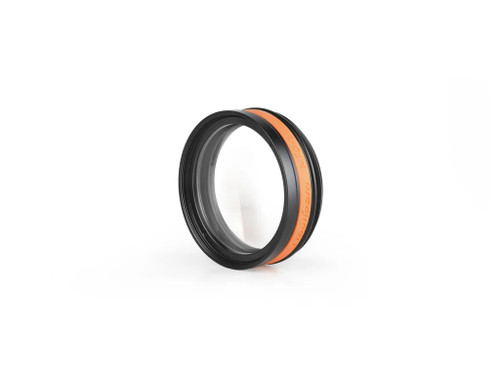
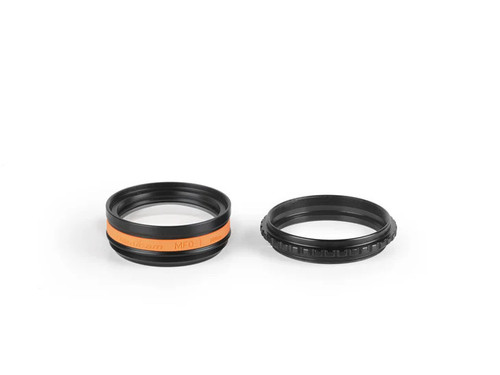
The Nauticam MFO-3 is a water-contact macro wet lens designed to work with longer macro lenses, especially 90mm, 100mm, and 105mm options. In practical terms, it gives those lenses a more useful mid-range macro look underwater, closer to a 50–60mm feel, while still keeping near life-size reproduction.
This is the lens we recommend when a shooter likes the reach of a long macro lens, but wants more framing flexibility for blackwater subjects, fish behavior, frogfish, or larger critters that feel too tight on a native 90–105mm setup. It is not a super macro diopter like the Nauticam SMC line; it is a workflow tool that makes a long macro system more versatile during the dive.
- Best for: full-frame macro shooters using Sony 90mm, Canon 100mm, or Nikon 105mm lenses who want a wider, more forgiving framing option without switching camera lenses between dives.
- Main advantage: it preserves near 1:1 macro capability while opening the field of view enough to make larger macro subjects and blackwater subjects easier to frame.
- Compatibility note: it uses an M67 thread and works best when paired with a compatible macro port, flip adapter, or bayonet mount. Compatibility varies by system — contact Bluewater Photo to confirm your setup.
- Why photographers choose it over alternatives: compared with the MFO-1 and SMC-3, the MFO-3 is the choice when you want longer working distance and a more mid-range, context-friendly macro look rather than extra magnification.
- Tradeoff: it is physically larger and heavier in air than the MFO-1, and it is not the right pick if your goal is true super macro magnification.
Official specifications from Nauticam. Test values listed by Nauticam were measured with the Nikon NIKKOR Z MC 105mm f/2.8 VR S Macro lens.
Will the Nauticam MFO-3 work with your setup?
Works With
- Canon RF 100mm f/2.8 L Macro IS USM
- Canon EF 100mm f/2.8L Macro IS USM
- Nikon NIKKOR Z MC 105mm f/2.8 VR S Macro
- Nikon AF-S VR Micro-NIKKOR 105mm f/2.8G IF-ED
- Sony FE 90mm f/2.8 Macro G OSS
- Also listed by Nauticam with select DX, Micro Four Thirds, and medium format options including Nikon 60mm DX, Olympus 60mm Macro, and Fujifilm GF 120mm.
Requires
- A compatible underwater housing and macro port sized correctly for the taking lens
- An M67-compatible front mount, or the correct adapter for a flip holder or Nauticam bayonet setup
- Enough physical clearance and port-chart confirmation for your specific lens and housing combination. Compatibility varies by system — contact Bluewater Photo to confirm your setup.
Optional Gear
- Flip adapter for switching in and out during the dive
- Nauticam bayonet mount for faster wet-lens changes
- Focus light for blackwater and night macro
- Float arms or buoyancy accessories to offset front-end weight on larger rigs
Why underwater photographers choose the MFO-3
Most macro wet lenses are about getting tighter. The Nauticam MFO-3 does something different: it makes a long macro lens more usable for medium-size subjects, more dynamic compositions, and faster-moving blackwater subjects. That makes it a smart choice for shooters who feel boxed in by a 90mm or 105mm lens but still want macro-level detail.
Compared with the Nauticam MFO-1, the MFO-3 gives up some magnification in exchange for more flexible framing and much longer working distance. Compared with the SMC-3, it is dramatically less specialized and much easier to use for everyday macro, blackwater, and larger critter work.
Why buy underwater gear like this from Bluewater Photo
- Nauticam has a strong reputation for premium underwater optics, housings, and support materials, including official port charts and compatibility tables.
- The MFO-3 uses hard-anodized aluminum construction and is depth rated to 100m.
- Bluewater Photo helps match camera bodies, housings, ports, wet optics, and lighting into a working real-world system.
Content reviewed by Bluewater Photo staff, recognized as the #1 online retailer specializing in underwater photography and scuba diving equipment, with real-world experience supporting, selling, and configuring underwater camera systems.
Ready to build a better macro setup?
Expert support from underwater photographers.
Comparison Table: Nauticam MFO-3 vs MFO-1 vs SMC-3
| Specification | MFO-3 (81503) | MFO-1 (81501) | SMC-3 (81203) |
|---|---|---|---|
| Dimensions (OD x H) | Ø 84 x 114.2 mm | Ø 70 x 26 mm | Ø 70 x 32 mm |
| Weight in Air | 602 g | 218 g | 307 g |
| Buoyancy in Water | Negative 120 g | Negative 150 g | Negative 215 g |
| Lens FOV / Converted FOV*1 | 23° / 38° | – | – |
| Max. Magnification*1 | 0.9× | 1.2× | 2.3× |
| Working Distance*1 | 0–1500 mm | 108–1005 mm | 46–98 mm |
| Lens Construction | 4 elements in 3 groups | 3 elements in 2 groups | 3 elements in 2 groups |
| Lens Coatings | Anti-reflection | Anti-reflection | Anti-reflection |
| Mount Thread | M67 | M67 | M67 |
| Depth Rating | 100 m | 100 m | 100 m |
*1 Tested with Nikon Nikkor Z MC 105mm f/2.8 VR S Macro lens.
Compatible Lenses with MFO-3
| Lens | Sensor format | Lens FOV. | Max. Magnification | Working distance | Converted FOV. |
|---|---|---|---|---|---|
| Canon RF 100mm f/2.8 L Macro IS USM | FF | 24° | 0.9X | 0-1490mm | 40° |
| Canon EF 100mm f/2.8L Macro IS USM | FF | 24° | 0.9X | 0-1490mm | 40° |
| Nikon NIKKOR Z MC 105mm f/2.8 VR S Macro | FF | 23° | 0.9X | 0-1500mm | 38° |
| Nikon AF-S VR Micro-NIKKOR 105mm f/2.8G IF-ED | FF | 23° | 0.8X | 5-1490mm | 38° |
| Nikon AF-S Micro NIKKOR 60mm f/2.8G ED | DX | 26.5° | 0.5X | 0-1500mm | 45° |
| Sony FE 90mm f/2.8 Macro G OSS | FF | 27° | 0.8X | 0-1500mm | 45° |
| Fujifilm GF 120mm f/4 Macro R LM OIS WR | Medium Format | 25.7° | 0.9X | 15-1500mm | 43° |
| Olympus M. Zuiko Digital ED 60mm f/2.8 Macro | M43 | 20° | 0.5X | 0-1500mm | 33° |
| OM System M.Zuiko Digital ED 90mm f/3.5 Macro IS PRO (Normal macro mode) | M43 | 14° | 0.7X | 0-1480mm | 23° |
| Canon EF-S 60mm f/2.8 Macro USM | APS-C | 24.5° | TBD | TBD | TBD |
| Panasonic Lumix S 100mm f/2.8 Macro | FF | 24° | TBD | TBD | TBD |
Recommended Accessories:
- Nauticam Flip Diopter for M67 Macro Port
- Nauticam Double Flip Diopter for M67 Macro Port
- Nauticam M67 Port to Bayonet Mount Converter for Wet Lenses
- Nauticam Bayonet Mount - CMC / SMC Adapter
- 83250 M67 to Bayonet Mount Converter II
- 83251 M77 to Bayonet Converter II
- 86221 M67 Flip holder for MWL-1
- 86222 Double Flip Holder for MWL-1
- 87501 Flip Holder for EMWL
Technical specifications
Build
- Dimensions: OD 84mm x H 114.2mm
- Weight in air: 602g
- Buoyancy in water: Negative 120g
- Body construction: Hard-anodized aluminum alloy
- Depth rating: 100m
Optics
- Lens construction: 4 elements in 3 groups
- Lens coatings: Anti-reflection coating
- Max magnification: 0.9x
- Lens FOV / converted FOV: 23° / 38°
- Working distance: 0–1500mm
Compatibility
- Mount thread diameter: M67
- Optimized for longer macro lenses, especially 90mm, 100mm, and 105mm full-frame options
- Officially listed compatible lenses include select Canon, Nikon, Sony, Fujifilm, and Olympus options
- Port chart confirmation recommended before purchase
All specifications and listed compatible lenses above are from Nauticam’s official product page and compatibility list. :contentReference[oaicite:25]{index=25}
- MFO-3 Wet Lens
- Front and rear rubber caps
- Neoprene bag
- M67 Spacer ring for SMC/CMC
- Cleaning cloth
Frequently asked questions
Will the Nauticam MFO-3 work with my Sony 90mm, Canon 100mm, or Nikon 105mm macro lens?
Those are the primary lens types the MFO-3 is designed around, and Nauticam officially lists compatible options for Sony FE 90mm, Canon RF and EF 100mm, and Nikon Z and F-mount 105mm lenses. You still need the correct housing, port, and front mount for your system.
Is the MFO-3 the same thing as a super macro diopter?
No. The MFO-3 is not a magnifier like the Nauticam SMC or CMC series. Its job is to make longer macro lenses more versatile underwater while keeping near life-size performance.
Do I need an M67 port to use the nauticam mfo-3?
You need an M67-compatible interface or the correct adapter solution. Nauticam lists the MFO-3 with an M67 mount thread and notes that it can be used on a flip holder, bayonet, or threaded mount depending on your setup.
Can I remove or reattach the MFO-3 during the dive?
Yes. One of the main advantages of this macro wet lens is that it can be detached and reattached in the water, which lets you switch between your native lens look and the MFO-3 look on the same dive.
Is the MFO-3 good for blackwater photography?
Yes, that is one of its strongest use cases. Nauticam specifically discusses its blackwater value, and other underwater retailers also point to blackwater and behavior shooting as a major reason to choose it.
How close can the MFO-3 focus?
Nauticam lists a working distance of 0–1500mm and a maximum magnification of 0.9x in its official specifications, with test values based on the Nikon Z 105mm macro lens. Real-world performance will vary with the taking lens.
Should I buy the MFO-3 or the MFO-1?
Choose the MFO-3 if you want more working distance and a more flexible, wider mid-range macro presentation. Choose the MFO-1 if you want more magnification and you already know you do not need the MFO-3’s broader framing advantage.
How should I maintain the MFO-3 after diving?
Rinse it thoroughly in fresh water after the dive, especially around the mount and thread area. Let it soak, operate the mount gently if applicable, and store it dry with the optical surfaces protected.