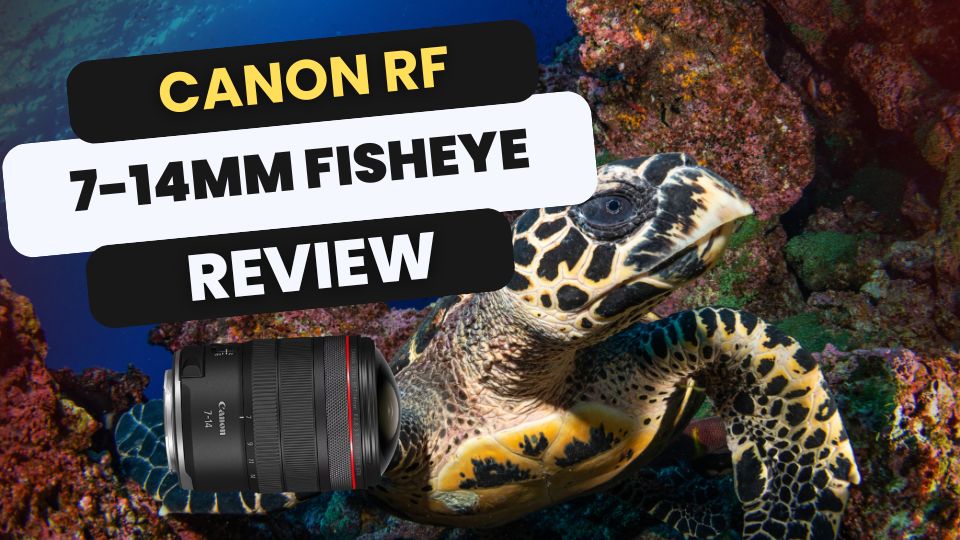
Canon RF 7-14mm f/2.8-3.5L Fisheye Lens Review
Posted by Nirupam Nigam on August 24th, 2026
Read Time: 7 minutes
Fisheye lenses are the workhorse of wide-angle underwater photography. Because water rapidly absorbs light and color, the best wide-angle images are often made by getting as close to your subject as possible, allowing your strobes to restore color and detail without having to travel through excessive water. Fisheye lenses are perfectly suited to this technique. Their extremely close minimum focusing distances let you position the lens just inches from a subject while still capturing an expansive field of view, producing sharp, colorful foregrounds against dramatic underwater backgrounds. Although fisheye lenses introduce barrel distortion, it is generally far less noticeable underwater, where straight lines are uncommon and the effect is further influenced by refraction through the housing's dome port.
Canon, alongside Nikon, has been known in the underwater photo community as a producer of the top fisheye focal length for full-frame cameras over the last two decades - the famous 8-15mm fisheye. This circular fisheye lens was compatible with the Canon EF mount and produced two types of images. The first is a 180 degree circular fisheye photo with a unique, slightly gimmicky globe look @ 8mm. The second is the classic rectangular fisheye photo with a diagonal field of view of 180 degrees @ 15mm. The focal lengths in between are relatively unusable as you begin to see vignetting. Traditionally, this focal length is also compatible with cropped sensor cameras, but you don't get the full circular effect at 8mm and you can crop in a bit more at 12-15mm.
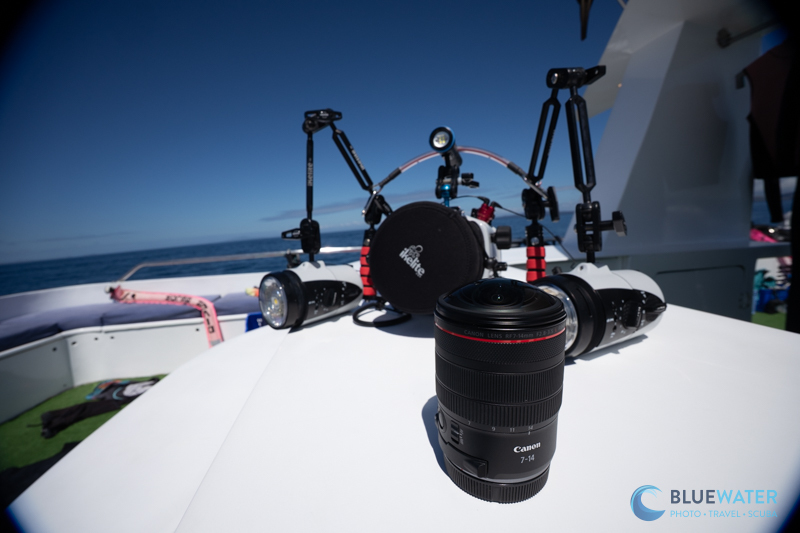
Canon RF 7-14mm fisheye lens in the field in the Galapagos
The original Canon EF 8-15mm was easily adaptable with the Canon EF-EOS R adapter to use with modern RF cameras, so I was quite surprised when Canon announced they had spent money on R&D for a replacement for such a niche lens! After all - who's watching skate videos these days? The new Canon RF 7-14mm lens is designed to be even WIDER than 180 degrees and faster - at f/2.8-3.5. So I was quite excited to try the lens with the Canon R6 Mark III on my recent underwater workshop with Bluewater Travel to the Galapagos this past spring. I dived and tested the lens in different dive conditions ranging from clear and blue to murky and green. And though I was hoping to experience something new and groundbreaking, I left the trip feeling as though I shot an excellent lens without a real change in my "color palette". Despite that - I think it's important to consider a couple of new capabilities the Canon RF 7-14mm brings to the table.
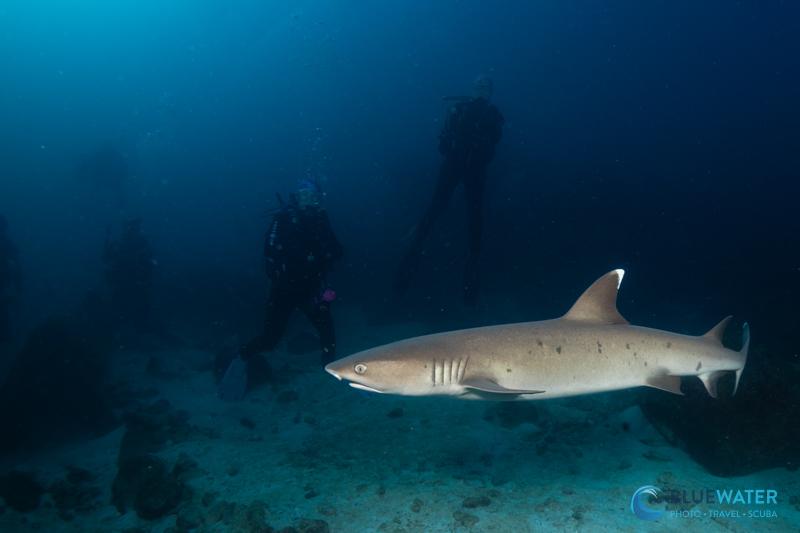
A photo of a white tip reef shark from my first dive with the Canon RF 7-14mm fisheye lens. 14mm, f/13, 1/160, ISO 320. Photographed with the Canon EOS R6 Mark III
Key Specifications
- Mount: RF
- Focal length - 7-14mm
- Max apeture: f/2.8 @ 7mm, f/3.5 @ 14mm
- Full frame field of view: 190 degrees @ 7mm, 180 degrees (diagonal) @ 14mm
- Image at widest end: circular fisheye
- Image at long end: diagonal/full frame fisheye
- Minimum focusing distance - 5.9 inches
- Max magnification - 0.35x @ 14mm
- Optical construction - 16 elements/11 groups
- Autofocus - STM
- Filters - rear drop-in
- 9 aperture blades
- No stabilization
- Size: 76.5 x 109.4mm
- Weight: 476 grams
- US MSRP: $1899
Key Features
The Canon 7-14mm fisheye lens has been updated with subtle improvements that deliver powerful optics when combined into a single lens. It is rated as Canon's premiere L-series lens - a title reserved for flagship lenses. And the 7-14mm certainly comes at a flagship price of $1899. The question becomes whether or not the lens can give underwater photographers something new that justifies upgrading from their workhorse 8-15mm fisheyes.
A Wider 190 Degree Field of View
Perhaps the standout feature of the 7-14mm is an even wider 190 degree field of view at 7mm (the circular image). This makes the Canon RF 7-14mm the world's widest autofocus zoom fisheye lens. At 190 degrees, the lens can theoretically see "behind" itself. Although I found it to be quite wide, I didn't find the new field of view to be very different underwater from the old 8-15mm fisheye. Shooting the lens was the same process and same difficulty of strobe positioning. Although the lens sees slightly wider, I didn't run into any issues with my strobes going into the frame as long as my strobe positioning was adequate. The main issue is figuring out how to light the whole area of your frame. ***Protip - try to place one strobe over the top and one underneath your camera to create even lighting in a circular frame.
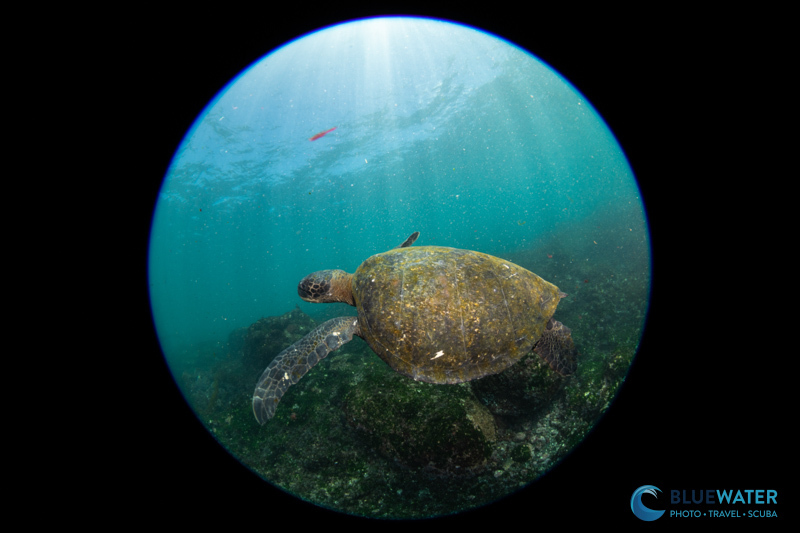
A 190 degree circular fisheye photo of a turtle captured at 7mm
Better Close Focus Wide Angle Capability
At 14mm, the field of view of the 7-14mm is about the same as the 8-15mm fisheye - with some slight differences. The 7-14mm is capable of focusing 0.3 inches closer with slightly more magnification of 0.35x at 14mm. This means you can fill more of your frame with your subject for better close focus wide angle. Did I notice this as well? No. But it's certainly one of the best lenses I've used for close focus wide angle! But ultimately, the 7-14mm fisheye felt like the same experience as shooting the 8-15mm fisheye when it came to field of view.
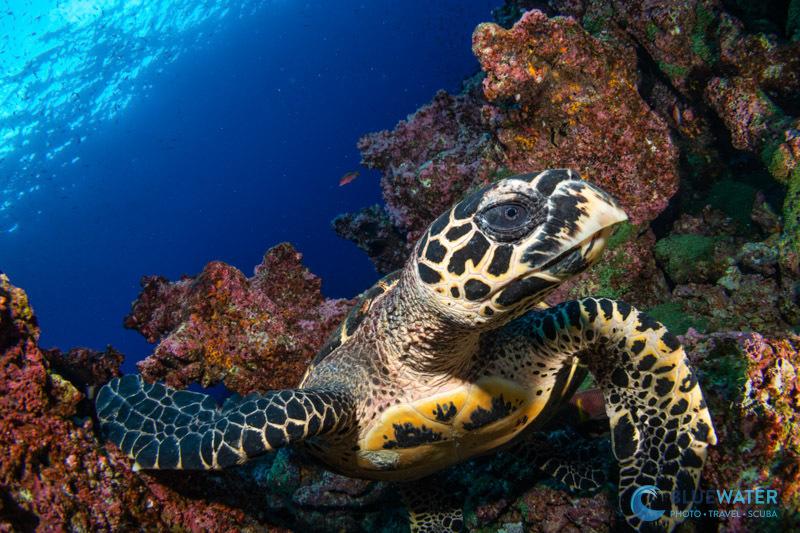
A 180 degree (diagonal) field of view of a turtle captured at 14mm. You can see just how well the lens performs with close focus wide angle subjects.
Fast Aperture of f/2.8-3.5
The Canon RF 7-14mm fisheye has a wider aperture than the Canon 8-15mm fisheye of f/2.8 @ 7mm and f/ 3.5 @ 14mm. This means that you can let in more light into your shot with a shallower depth of field. However, for underwater photography it's a bit of a moot point. In the majority of my underwater wide angle images, I tend to shoot at f/13 for higher on a full frame camera so that the corners of my images look sharp. The virtual image behind a dome can add more aberration than you would normally see above water. However, for some close focus wide angle photos where you might want a lot of background blur (bokeh), a wider aperture could prove useful.
The faster aperture is most useful for astrophotography, where I can see the RF 7-14mm doubling quite well for the role.
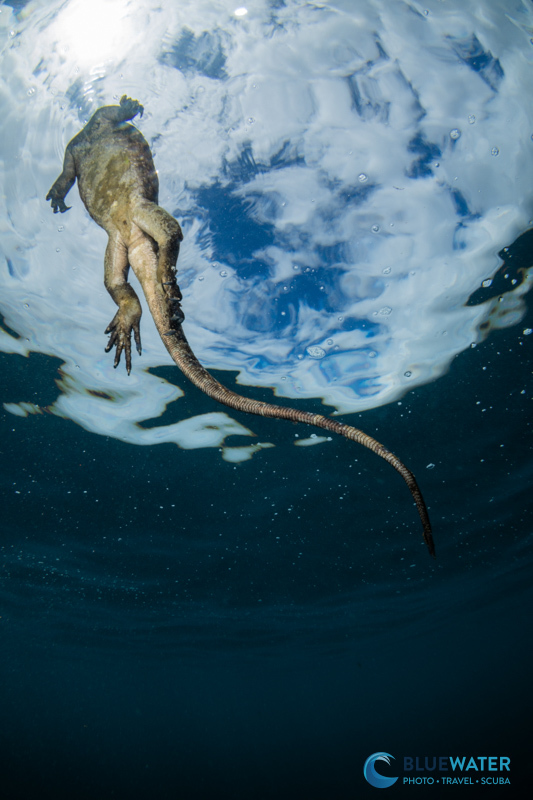
A marine iguana swims to the surface with the Canon RF 7-14mm capturing snell's window
Premium Image Quality
As an L-series lens, the Canon RF 7-14mm performs much better optically than its predecessor. It's equipped with a more ambitious optical design of 16 elements in 11 groups. Five of the elements are UD and two are aspherical. Canon also added an ASC coating on three lens surfaces. So you can expect better sharpness, reduced color fringing, reduced flare, and reduced ghosting compared to the 8-15mm. I actually do think this is true. Take a look at the circular fisheye image above - you can see that there isn't nearly as much blue ghosting around the edges of the frame as there was in the 8-15mm. That said, most images will be close to identical in image quality. I find that placing great optics behind an acrylic dome port is a bit of an equalizer. The image quality won't look too different between the Canon EF 8-15mm and the Canon RF 7-14mm. Behind a glass port? Perhaps. But perhaps more importantly, the Canon RF 7-14mm lens is an RF lens. So you can expect sharper corners with the reduced flange distance inherent of the lens mount.
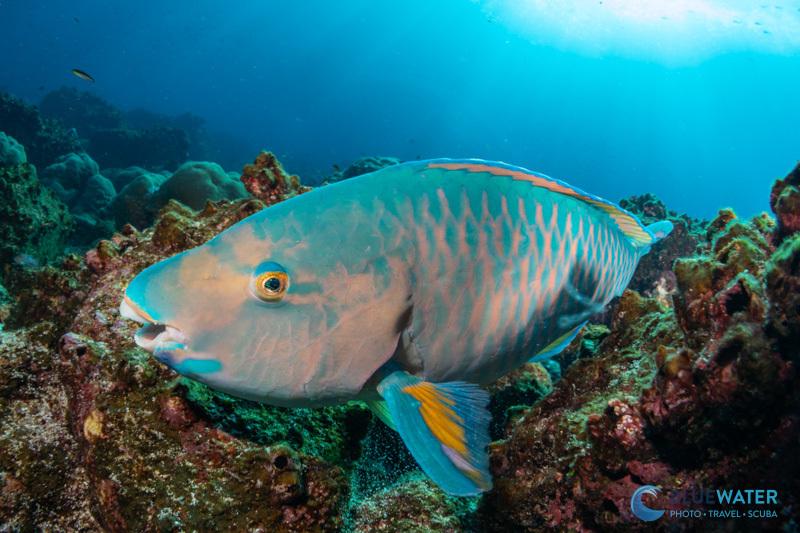
A parrotfish photographed with the Canon 7-14mm fisheye lens @ 14mm. f/13, 1/125, ISO 320
Canon EF 8-15mm Fisheye vs Canon RF 7-14mm Fisheye
As I explained above, the Canon RF 7-14mm lens is a more premium lens than the Canon 8-15mm fisheye. It has better optical coatings, lens elements, and a wider field of view. It can also theoretically produce sharper corners with the RF lens mount and more magnification for close focus wide angle images (especially in the center of the frame). That said, in practice, I find it difficult to find many differences between the Canon 8-15mm fisheye and the Canon RF 7-14mm fisheye when I use both underwater. If you do a lot of circular shooting then you will notice the RF 7-14mm does produce less ghosting. But would I upgrade from the Canon EF 8-15mm fisheye lens to the Canon RF 7-14mm fisheye lens? Probably not. Would I buy the Canon 7-14mm fisheye if I needed to start from scratch and buy my first fisheye lens? Definitely. Even at the $1899 price point.
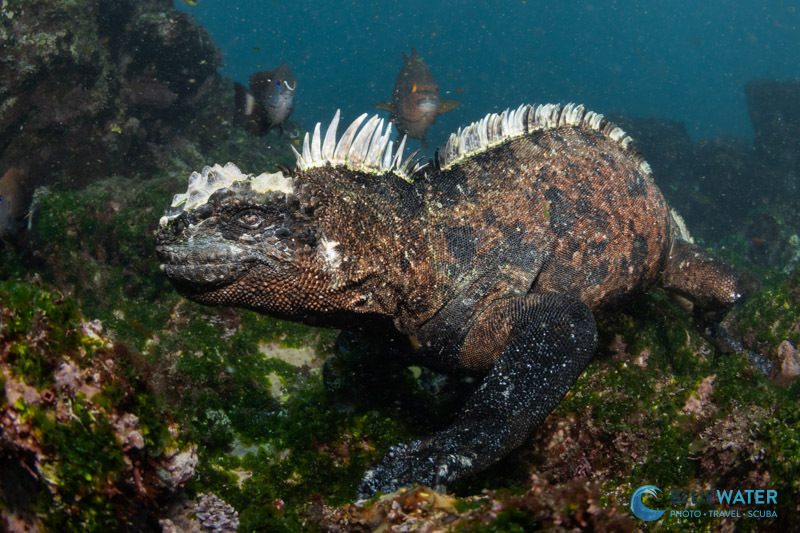
A marine iguana portrait photographed with the Canon RF 7-14mm fisheye lens @ 14mm
Conclusions
The Canon RF 7-14mm f/2.8-3.5 L Fisheye is arguably the best fisheye Canon has ever made. It's wider, faster, optically more sophisticated, focuses slightly closer, and offers native RF-mount compatibility without an adapter. Canon has improved almost every measurable specification over the venerable EF 8-15mm, and the reduction in ghosting and color fringing is particularly noticeable when shooting circular fisheye images toward bright light.
But after diving with the lens extensively in the Galapagos, I don't think those improvements fundamentally change the underwater shooting experience. At 14mm, I composed and lit my images much the same way I would with the EF 8-15mm at 15mm. The extra 10 degrees at the circular end is interesting; the faster aperture has some specialized uses, and the improved optics are welcome—but none of them substantially expanded my creative "color palette." That said, if I was asked to select the best fisheye lens I've ever shot - the Canon 7-14mm fisheye is it.
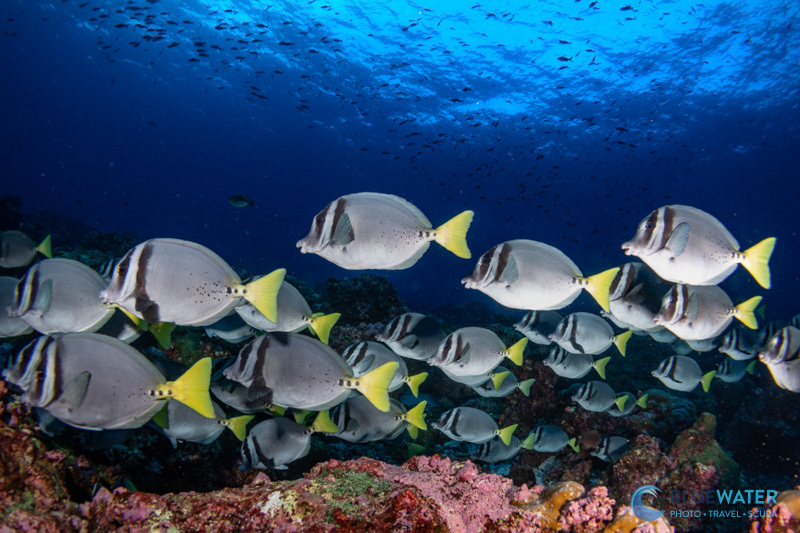
A school of yellowtail surgeonfish photographed with the Canon 7-14mm fisheye lens