
Best Dive Computers, Tested Hands-On by Divers (2026 Guide)
Posted by Elma Tarr on February 7th, 2026

Our Guide to the Best Dive Computer for Every Diver
Being a PADI Staff Instructor myself, I have searched high and low over the years to find the perfect dive computer that suits my diving needs, and have been fortunate to test out some of the best dive computers ever released. As I often say to my students, your dive experience can be completely changed just by choosing the right dive computer for you. No two computers are made the same, and technology is always changing. With this in mind, I was eager to test as many newer dive computers on the market as I could, along with some of our team members, in order to create this in‑depth guide of the best dive computers 2026.
We decided to take these computers diving in a super wide range of conditions, various depths, and at a number of locations, with many of our dive travel trip leaders volunteering to take these computers to incredible parts of the globe, from South Africa, Galapagos, Fiji, California to the Philippines (I mean, who doesn't want to try great gear?). Throughout the tests, we paid close attention to categories like user interface, connectivity, display clarity, battery life, safety features, and overall value. At the end of our test period, which ran for a couple of months so that we could see genuine results, we shared our notes and findings, which you will find below. This is of great importance to us at Bluewater Photo and Scuba, as it allows us to share honest opinions with real-world experience, and ensures that you get the freshest info- because nothing undermines safety like outdated gear in your kit.
I have found that navigating ocean conditions, nitrogen loading, gas mixes, and decompression limits takes precision—and your diving equipment definitely matters. I have spotlighted all leading brands like Shearwater dive computer, Oceanic dive computer, Garmin dive computer, Cressi dive computer, and Mares dive computer below. I have also highlighted standout options like the best dive computer for beginners, making it easy to find the right match whether you're starting out or upgrading. I am sure by the end, you'll know which model deserves a place on your gauge console or wrist for your next underwater adventure.
Quick Guide to the Best Dive Computer:
- Best Overall Dive Computer - Shearwater Peregrine TX Dive Computer
- Best Budget Dive Computer - Mares Puck 4
- Best Dive Computer for Beginners - Shearwater Peregrine
- Best Dive Computer Watch - Suunto Ocean Dive Computer
- Best Air-Integrated Dive Computer - Garmin Descent Mk3i Dive Computer Smartwatch
- Best Technical Dive Computer - Shearwater Perdix 3
- Jump to Section -
Comparison Table of Our Best Dive Computers
| Model | Display | Gas Modes | Air Integration | Depth Rating | Battery | Algorithm | Smart Features | Shop |
|---|---|---|---|---|---|---|---|---|
| Shearwater Peregrine | 2.2″ full-color LCD (320×240) | Air, Nitrox, 3-Gas Nitrox, Gauge | No | 120 m / 394 ft | Rechargeable Li-ion, up to ≈30 h | Bühlmann ZHL-16C + GF | Bluetooth, wireless charging, vibration alerts, firmware updates | Buy Now |
| Shearwater Peregrine TX | 2.2″ full-color LCD (320×240) | Air, Nitrox, 3-Gas Nitrox, Gauge | Yes, up to 4 transmitters | 120 m / 394 ft | Rechargeable Li-ion, up to ≈30 h | Bühlmann ZHL-16C + GF | Digital compass, Bluetooth, wireless charging, firmware updates | Buy Now |
| Suunto Ocean | 1.43″ AMOLED touchscreen, sapphire | Air, Nitrox / Multi-Gas, Freedive | Yes (Suunto Tank POD) | 60 m / 197 ft | Up to ≈60 h dive / ≈26 days smartwatch | Suunto Bühlmann 16 GF | GPS, 95+ sports, health tracking, notifications, Suunto app | Buy Now |
| Garmin Descent Mk3i | AMOLED, sapphire (1.2″ 43 mm / 1.4″ 51 mm) | Air, Nitrox, Trimix, CCR, Gauge, Apnea | Yes (T2 transceiver / SubWave) | 200 m / 656 ft | Up to 30 h (43 mm) / 66 h (51 mm) dive mode | Bühlmann ZHL-16C + GF | GPS, DiveView maps, health tracking, music, Garmin Pay, notifications | Buy Now |
| Mares Puck 4 | 800-segment chip-on-glass LCD | Air, Nitrox, up to 3 gases, Bottom Timer | No | 150 m / 492 ft | User-replaceable CR2450, up to ≈100 dives | Bühlmann ZH-L16C + customizable GF | Bluetooth, dive log, decompression planner, firmware updates | Buy Now |
| Shearwater Perdix 3 | 2.4″ full-color AMOLED (450×600) | Air, Nitrox, Trimix, CCR, Gauge, Freedive | Yes, up to 4 transmitters | 260 m / 850 ft | User-replaceable AA, up to ≈60 h with lithium AA | Bühlmann ZHL-16C + GF | Digital compass, Bluetooth, vibration alerts, firmware updates | Buy Now |
The Best Overall Dive Computer
Shearwater Peregrine TX Dive Computer
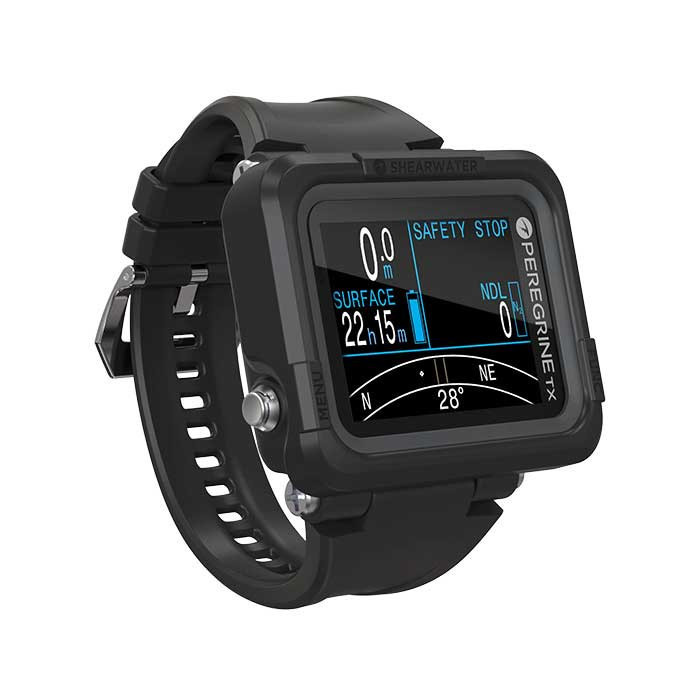
The Shearwater Peregrine TX Dive Computer is a combination of two of Shearwater's other leading dive computers, with a large, easy-to-read, two button user interface of the the Peregrine, and the advanced features of the Perdix 2, such as air aitegration and digital underwater compass. This computer is made for sports divers, offering both convenience and performance.
Nirupam, the CMO of Bluewater Photo and Scuba, has this to say about the Shearwater Peregrine TX: "When I am in the ocean trying to get the perfect shot, I need equipment I can rely on 100%. The Shearwater Peregrine TX dive computer with its 2.2" vibrant LCD displays shows me everything I need to know in an easy to read format, even with a large camera rig in my hands."
On this clear display, you can have accurate real-time air data with the air integartion features when pairing the Peregrine TX with a Shearwater Swift transmitter. The Peregrine TX can support up to 4 transmitters simultaneously. Other dive features include Air, Nitrox (3 gasses up to 100% O2), and gauge. It is a great computer if you are a side mount diver. What we really enjoy about the Peregrine TX is it's wireless charging capabilities.
The Peregrine TX is best for: Side-mount divers, instructors, and travelers who want top-end dive features with wristmounted convenience. Also for those divers who enjoy reading data from a big, clear screen.
It is not well suited for: Divers who want a computer with smartwatch capabilities, or want a slim looking computer. It is also not made for tech divers who need Trimix or CCR features.
Key Features of the Shearwater Peregrine TX Dive Computer:
- Display: 2.2 in (5.59 cm) full-color LCD with a resolution of 320 x 240 QVGA
- Battery: Rechargeable Li-ion battery lasting up to 30 hours on medium brightness
- Depth rating: 394 ft (120 m)
- Dive log capacity: Approximately 400 hours or 750 dive entries.
- 4 Transmitters supported
- Case: Ballistic nylon polymer
- Strap: 1 in (2.6 cm) silicone band with stainless steel clasp
- Interface: Two buttons
- Modes: Air, nitrox (up to 40%), three gas nitrox (up to 100% O2), and Gauge
- Algorithms: Bühlmann ZHL-16C, Bühlmann GF
- Features: Automatic altitude adjustment, NDL planner, full decompression planner, conservatism options, vibration alerts, Bluetooth dive log uploading to Shearwater Cloud, firmware upgrades over Bluetooth, programmable depth sampling rates
The Best Overall Dive Computer
Garmin Descent Mk3i Dive Computer Smartwatch
Garmin raises the bar once again with the Descent Mk3i, one of their most advanced dive computer smartwatches that blends cutting-edge dive technology with everyday wearability. Engineered for both recreational and technical diving, this high-end Garmin dive computer supports multiple gas mixes including air, Nitrox, Trimix, and CCR, making it a powerhouse for serious underwater exploration.
This is a favorite among divers, including some of our staff, for various reasons. As mentioned by Wayne Tarr, one of our sales experts, compared to some other computers, the Mk3i's screen is large and easy to read, boasting a vibrant 1.4” AMOLED display with an extremely durable sapphire crystal and a titanium bezel for added strength at depth. With a maximum depth rating of 200 meters, this watch-style dive computer is built to thrive in demanding conditions. Full air integration is available when paired with the Garmin Descent T2 transmitter, allowing for real-time tank pressure tracking and SubWave sonar-based diver-to-diver communication — a standout feature among the best dive computers.
Smart dive modes include single-gas, multi-gas, gauge, apnea, and spearfishing modes, as well as advanced features like customizable dive screens, decompression and no-fly time tracking. As Wayne says, the GPS tracking is a feature that many people don't consider. While GPS obviously doesn't work underwater, your entry and exit points are accurately recorded on GPS. He also says that he enjoys the simple logging of dives. Hand written log books are a thing of the past. With the Garmin Dive app connected from your phone to your dive computer, all the essentials of your dive are logged, and then you can edit these entries with as much detail as you'd like and everything is logged in dive number sequence. The Mk3i also includes a 3-axis compass, depth and ascent rate alarms, and automatic dive log sync to the Garmin Dive app.
Outside the water, the Descent Mk3i transforms into a fully-featured smartwatch with multi-band GPS, heart rate monitoring, Pulse Ox, sleep tracking, smart notifications, music storage, contactless payments, and more. Wayne also raves about the multiple sports features, he makes use of the running, cycling, swimming and golf features frequently. It offers up to 25 days of battery life in smartwatch mode and up to 66 hours in dive mode, making it an ideal all-in-one companion for adventure travelers.
The Descent Mk3i is best suited for: Technical and recreational divers, Dive professionals, Freedivers, and those with an adventerous spirit who look for premium features in and out of the water.
The Descent Mk3i is less ideal for: Casual or beginner divers looking for something simple, and those divers who are a tighter budget.
Key Features of the Garmin Descent Mk3i
- Advanced, watch-style dive computer featureseither 43 mm / 1.2″ and 51 mm / 1.4″ versions. Garmin specifies titanium bezels for Mk3i variants.
- Dive-first design with 200-meter dive-rated case includes metal leakproof inductive buttons and multiple dive modes for recreational to technical scuba diving and freediving
- Enhanced SubWave sonar technology provides the ability to exchange preset diver-to-diver messages up to 30 meters
- DiveView maps offer bathymetric depth contours and more than 4,000 dive sites to help you find where to dive and get oriented
- Dive logs automatically sync with the Garmin Dive app downloaded to your compatible smartphone

The Dive Computer Computer Watch
Suunto Ocean Dive Computer & Smartwatch
If you've been looking for a beautiful, smartwatch-style dive computer that doesn’t compromise on functionality, I would definitely say the Suunto Ocean is a top contender. This 2-in-1 dive computer and smartwatch is designed for the modern diver, it combines sport features like heart rate and activity tracking with serious dive capabilities. Read the full dive computer review.
Jamie Ayliffe, a scuba instructor and one of our team members, took this dive watch diving over numerous dives, and especially enjoyed the bright, easily readible screen with a 1.43" AMOLED display. She says in her review that even at 25 meters deep, in really poor visibility, she had no issues reading the important data such as dive time, depth and NDL limits. Jamie also mentions that it has a very friendly user-interface, especially for divers moving up from simpler models such as the Zoop, with the three buttons easy to navigate (even when diving with thick gloves!).
The Ocean supports up to five gas mixes, including Nitrox up to 100%, and offers seemless air integration via the Suunto Tank Pod. As with the other Suuntos, this is one of the best air integrated computers. The watch automatically logs dive entry and exit points using built-in GPS. You can view 3D dive paths post-dive using Suunto’s mobile app — which is really unique and a great tool for divers looking to track their dive routes. The battery life is strong too, giving you around 60 hours of dive time. Suunto’s Bühlmann 16 GF algorithm is reliable and well-known in the dive industry.
Best for: Divers wanting a smart design with high-end air integration and post-dive data. I also recommend this for divers who lead active lifestyles and do not feel like swapping out devices every time they dive.
Not well suited for: Tech divers who go to greater depths and need Trimix or CCR functions. Having slim wrists, I also find that as a smartwatch, it is on the bulkier side, but it is still slim for a dive computer.
Main Features of the Suunto Ocean Dive Computer
- Certified Dive Computer: Scuba dive computer capable to 60 m with air, nitrox, multigas support
- Suunto Bühlmann 16 GF algorithm: User-configurable decompression profiles
- Wireless Air Integration: Suunto Tank Pod pairing to monitor tank pressure and buddy gas usage
- 3D Dive Mapping: Visualize dive route in 3D within Suunto App
- AMOLED Touchscreen: 1.43″ high‑contrast display readable underwater and in bright daylight
- Durable Build: Sapphire crystal, stainless steel bezel, polyamide case for rugged performance
- Dual-Band GNSS & Offline Maps: GPS, altimeter, barometer, compass, contour maps accessible off‑line
- 95+ Sport Modes & Health Tracking: From swimming to yoga; sleep, recovery, HRV, calorie tracking
- Smartwatch Functionality: Notifications, music control, phone locator, custom watch faces
- Extended Battery Life: Up to 60 hours of dive use, 50 hours GPS tracking, 26 days in daily mode
- Eco-Conscious Manufacturing: Carbon offset, renewable energy production in Finland

The Best Recreational Dive Computer for Beginners
Shearwater Peregrine Dive Computer
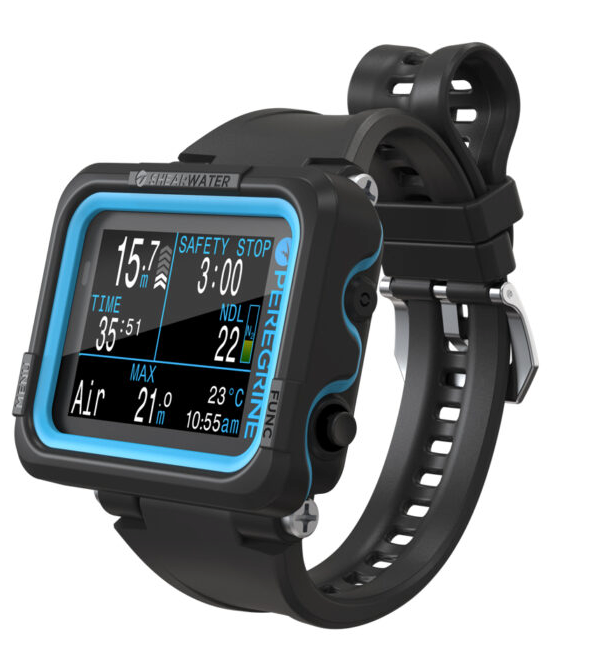
The Shearwater Peregrine Dive Computer is one of my favorite options for recreational divers who want a simple computer that they will not quickly outgrow. It combines Shearwater's very easy-to-use two-button interface with a large 2.2" full-color LCD display, making important dive information clear and easy to read underwater. For newer divers, it is straightforward enough to learn quickly, while more experienced recreational divers will appreciate the additional control it offers as their diving progresses.
What I particularly like about the Peregrine is that it uses the trusted Bühlmann ZHL-16C decompression algorithm with customizable Gradient Factors. This gives divers more control over how conservative they want their dive computer to be, rather than locking them into a fixed algorithm. It supports Air, Nitrox and 3 Gas Nitrox, including gas switching during a dive, and it also offers full decompression support with a built-in decompression dive planner.
The Peregrine is also very practical for everyday diving. It has a rechargeable battery with up to approximately 30 hours of dive time, wireless charging, Bluetooth connectivity for downloading dive logs and updating the computer, customizable screen layouts and strong vibration alerts. The large color display is one of its biggest advantages over many entry-level dive computers, especially for divers who prefer to see their depth, no-decompression limit and other important information at a glance.
I think the Shearwater Peregrine sits in a particularly useful middle ground. It is simple enough for a newer recreational diver, but offers considerably more room to progress than a basic beginner dive computer. It can even support limited decompression and multi-gas diving, although divers planning to move seriously into trimix, CCR, sidemount or air-integrated technical diving should look toward computers such as the Peregrine TX or Perdix series.
The Shearwater Peregrine is best for: Beginner through advanced recreational divers looking for an easy-to-use color screen dive computer, Nitrox divers, and divers who want a computer with customizable Gradient Factors and enough capability to grow into limited multi-gas and decompression diving.
The Shearwater Peregrine is less suited for: Technical divers who require trimix or CCR support, divers who want air integration or a built-in digital compass, and those looking for a smartwatch-style dive computer with everyday fitness and lifestyle features.
Key Features of the Shearwater Peregrine Dive Computer
- Large 2.2-inch full-color LCD display for clear, easy-to-read dive information
- Bühlmann ZHL-16C decompression algorithm with customizable Gradient Factors
- Air, Nitrox, 3 Gas Nitrox and Gauge modes
- Supports multi-gas diving with up to 3 gases
- Full decompression diving support with built-in decompression planning
- Easy two-button interface designed for simple underwater navigation
- Rechargeable battery with approximately 30 hours of dive time
- Wireless charging for convenient recharging between dives
- Bluetooth connectivity for dive log downloads and firmware updates
- Compatible with the Shearwater Cloud app
- Customizable screen layouts and dive information displays
- Strong vibration alerts for important dive notifications
- Large onboard dive log capacity
- 120 m / 394 ft depth rating
- Durable, travel-friendly design
- Ideal for beginner, recreational and advanced recreational divers
- Offers enough capability for divers progressing into Nitrox, multi-gas and limited decompression diving
- No air integration, trimix or CCR support, making it better suited to recreational rather than full technical diving
The Best Dive Computer for Beginners
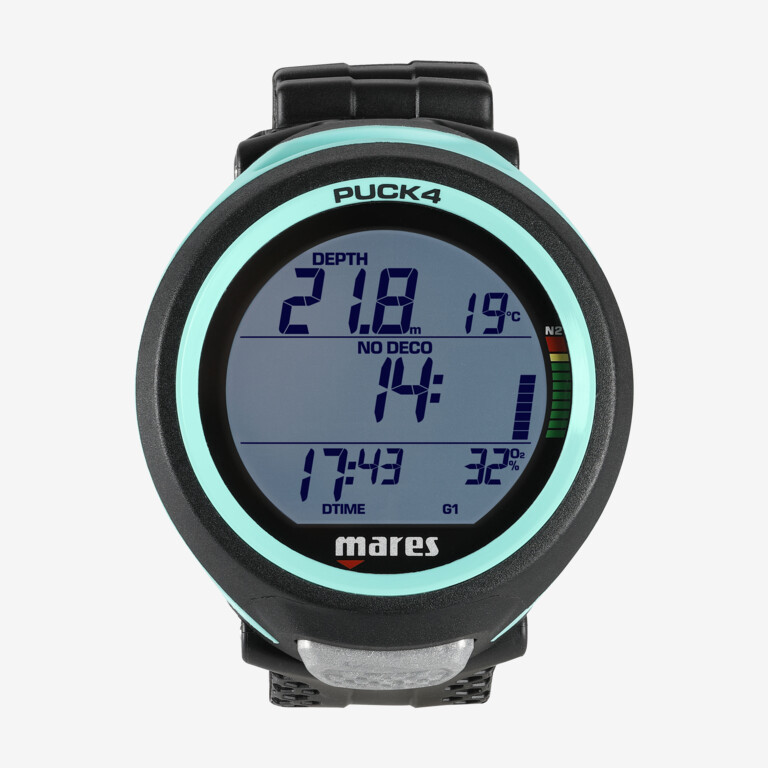
Mares Puck 4 Dive Computer
The Mares Puck 4 is rated as one of the best dive computers for beginners, but is perfectly suited for recreational divers who enjoy easy dives within their limits. Jamie Ayliffe, from our team, says she taught many of her students in Fiji how to use this computer during their Open Water courses.
What many divers enjoy the most about this computer is that it uses the Bühlmann ZH-L16C algorithm and it has customizable gradient factors, which gives divers more control over the computer's conservatism. This computer offers multi-gas capabilities (up to 3 gases), Nitrox and bluetooth connectivity. Jamie says that her favorite features is the large and clear screen and easy to replace battery. It is simple but still so safe.
The Mares Puck 4 is best for: Beginner or recreational divers looking for a simple and easy-to-use computer that comes at an affordable price. It is also a great option for divers who are looking to start leveling-up and experiementing with Nitrox. This computer is also a fantastic rental piece for dive operations.
The Mares Puck is not well suited for: Puck 4 supports up to three gases and has a decompression dive planner. It isn't a trimix/CCR technical computer, but it can manage decompression obligations. It is also not a good option for people who like a color screen and a many-button computer face.
Key Features of the Mares Puck 4 Dive Computer
- Bühlmann ZH-L16C decompression algorithm with customizable Gradient Factors
- Air, Nitrox and Bottom Timer modes
- Multi-gas capability with support for up to 3 gases
- Nitrox support for recreational and more advanced diving
- Decompression dive planner with user-adjustable surface interval
- Clear 800-segment display using chip-on-glass technology
- Single-button interface for simple, intuitive operation
- Bottom Timer mode with resettable average depth and stopwatch
- Built-in Bluetooth for direct connection to the Mares and SSI apps
- Dive log capacity for up to 100 dives
- Firmware updates through the Mares app
- User-replaceable CR2450 battery
- Approximately 100 dives of battery life
- Removable strap system that can be easily replaced with a bungee
- Compact, lightweight design well suited to travel and recreational diving
- Available in multiple color options
The Best Dive Computer for Technical Divers
Shearwater Perdix 3 Dive Computer
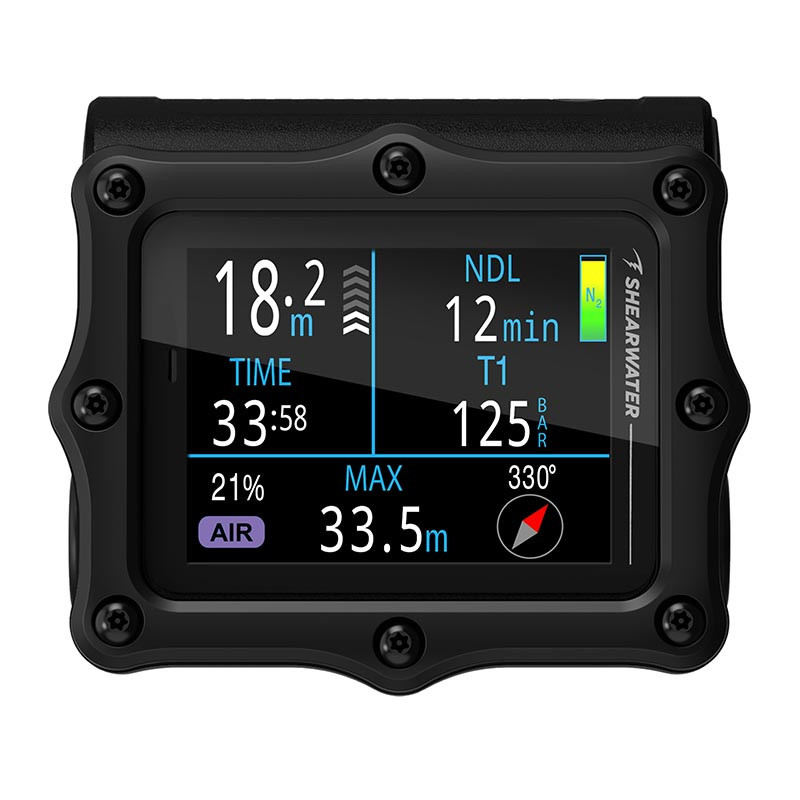
The Shearwater Perdix 3 Dive Computer is Shearwater's latest full-size dive computer, designed for divers who want a large, highly visible display with the technical capability to support everything from recreational diving through advanced trimix and CCR diving. It combines a rugged armored case and titanium bezel with a bright 2.4" full-color AMOLED display, making important dive information easy to read in low visibility, at depth, or during more demanding dives.
What I believe really sets the Perdix 3 apart is the combination of advanced technical diving features with a very straightforward interface. It supports multi-gas decompression, trimix and CCR diving, along with Air, Nitrox, 3 Gas Nitrox, Gauge and Freediving modes. Like other Shearwater dive computers, it uses the trusted Bühlmann ZHL-16C decompression algorithm with adjustable Gradient Factors and includes integrated NDL and decompression planning tools. This gives experienced divers plenty of control over their decompression settings without making the computer unnecessarily complicated to operate.
The Perdix 3 also offers wireless air integration and can connect with up to four Shearwater transmitters, including the Shearwater Swift Transmitter(or Swift GPS Transmitter). This makes it particularly useful for sidemount divers, stage and decompression cylinders, or divers who simply want their tank pressure displayed directly alongside their other dive information.
Despite being a very capable technical dive computer, the Perdix 3 remains easy to use. The two-button interface has been refined for faster navigation, while customizable Big, Standard and Tec screen layouts let you decide how much information you want displayed underwater. It also retains one of my favorite features of the Perdix series: a user-replaceable AA battery. High-speed Bluetooth allows dive logs and firmware updates to be managed through the Dive Shearwater app.
For divers looking for one computer that they can continue using as their diving becomes more advanced, the Shearwater Perdix 3 is one of the strongest options available. It has the simplicity required for everyday recreational diving, but enough capability for technical, trimix, sidemount and CCR diving without needing to replace the computer as your diving progresses.
The Shearwater Perdix 3 is best for: Technical divers, advanced recreational divers, sidemount and CCR divers, and anyone looking for a large-screen dive computer that can support them throughout their diving career.
The Shearwater Perdix 3 is less suited for: Divers looking for a basic entry-level dive computer, or those who specifically want a compact smartwatch-style dive computer with fitness, health and everyday smartwatch functions.
Key Features of the Shearwater Perdix 3 Dive Computer:
- Air / Nitrox / 3 Gas Nitrox: 3 gas nitrox recreational computer
- OC Tec: Multi gas, trimix decompression computer
- CC / BO: Closed circuit fixed PPO2
- Gauge: Bottom timer with stop watch and dive logging
- Screen resolution: 2.4″ full-color AMOLED, 450×600
- Display type: LCD with LED backlight
- Display size: 5.59cm / 2.2″
- Battery type: Single AA (any type)
- Battery life: Lithium 1.5V - up to 60 Hours
- Dive log: Approximately 1,000 Hours
- Depth rating: 260m / 850ft
- Available in DLC Black or Titanium version
Frequently Asked Questions about our Dive Computers
What is a dive computer?
A dive computer tracks your depth, dive time, ascent rate, and decompression status throughout a dive, calculating your no-decompression limit and decompression information according to its algorithm and settings. Most modern dive computers also track safety stops, surface intervals, water temperature, and previous dives. More advanced models add features such as air integration, digital compasses, multiple gas mixes, technical diving modes, and smartwatch functions.
Which dive computer is best for beginners?
The best dive computer for beginners is usually one with a clear display, simple controls, an easy-to-understand dive screen, and straightforward safety information. Entry-level divers generally do not need advanced technical modes, but features such as a rechargeable battery, Bluetooth log syncing, and a good backlight can make a computer much easier to live with. Models such as the Shearwater Peregrine, Suunto Zoop Novo, and similar easy-to-read recreational dive computers are popular starting points.
Do I need air integration?
Air integration allows a compatible dive computer to display your remaining tank pressure using a wireless transmitter connected to your regulator. It is not required for recreational diving, and many divers are perfectly happy using a traditional pressure gauge. However, an air-integrated dive computer can put depth, remaining gas, dive time, and decompression information on one screen, making it particularly useful for divers who want a cleaner setup or more detailed gas-consumption data.
Dive computer watch vs large-screen dive computer
A dive computer watch is smaller and designed to be worn every day, making it a good choice for travel, freediving, fitness tracking, and divers who do not want to carry a separate computer. Larger dive computers generally provide bigger screens, larger numbers, and easier-to-read information underwater, especially in low visibility or when wearing thick gloves. If diving is your main priority, a large-screen computer can be easier to use; if you want one device for diving and everyday wear, a watch-style dive computer may make more sense.
Bühlmann vs proprietary dive computer algorithms
Many dive computers use the Bühlmann decompression algorithm, often combined with adjustable Gradient Factors that allow divers to control how conservative their decompression profile is. Other manufacturers use proprietary algorithms with their own approach to calculating no-decompression limits and decompression obligations. Neither approach automatically makes a dive computer safer or better; the important thing is understanding how your computer behaves and using consistent settings. Bühlmann-based computers are especially popular with advanced and technical divers because the algorithm and Gradient Factor settings are widely understood.
Garmin vs Shearwater vs Suunto
Garmin, Shearwater, and Suunto dive computers each suit slightly different divers. Garmin is particularly strong for divers who want a premium dive computer combined with smartwatch, fitness, GPS, and multisport features. Shearwater focuses heavily on diving, with clear displays, intuitive menus, and strong support for recreational through technical diving. Suunto offers a broad range from straightforward recreational computers to advanced watch-style models and is a familiar choice for divers who value simple interfaces and a long history in dive instrumentation. The best option depends more on how and where you dive than on the brand alone.
How much should I spend on a dive computer?
You do not need to buy the most expensive dive computer to dive safely. Basic recreational dive computers typically provide all the essential information needed for normal no-decompression diving, while spending more generally adds features such as color displays, air integration, GPS, rechargeable batteries, smartwatch functions, multiple gas support, and technical diving modes. For most recreational divers, the best value comes from choosing a computer that covers the type of diving you do now while leaving some room for your diving to progress.
Why Trust Bluewater Photo?
Our team includes professional underwater photographers and videographers with over 15 years of experience testing and photographing underwater to ensure you get thorough first hand experience and trusted reviews.
Expertise in Underwater Photography: Run by passionate divers and photographers who truly understand the gear and how it performs in real-world conditions.
Competitive Pricing: Offers competitive prices with added value like expert advice and top-tier customer support. We will match and beat any price!
Established Reputation: Trusted by thousands of divers, photographers, and professionals worldwide.
Exceptional Customer Support: Personalized service from knowledgeable staff who care about getting you the right gear.
Transparent and Honest Advice: Recommendations are based on what’s best for your needs—not just what’s in stock.
Meet Our Expert


Elma Tarr
Elma Tarr is the Scuba Gear Brand Manager at Bluewater Photo and an IDC Staff Instructor with over 3,500 dives to her name. Her passion for the underwater world began over 21 years ago, and she has since turned that passion into a thriving profession.
Elma’s interest in dive gear was sparked by a key insight early in her teaching career: one of the biggest obstacles for new divers was often improperly fitting equipment. This realization drove her to deepen her expertise in gear selection, fit, and performance, making her a trusted resource for divers of all levels.
An avid traveler and underwater photographer, Elma has explored dive sites across the globe, with a special love for macro photography. Her blend of field experience, technical knowledge, and customer-first mindset makes her an invaluable part of the Bluewater Photo team.