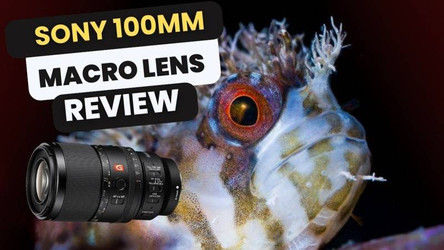
Sony 100mm Macro Lens Review
Posted by Nirupam Nigam on April 30th, 2026

The Sony FE 100mm f/2.8 macro lens is one of the most exciting things to happen to Sony underwater macro shooters in the last decade. It represents a significant update to the Sony 90mm f/2.8 macro lens which has been Sony's most popular macro lens since 2015. The lens has been upgraded to bring it up to speed with Canon's popular RF 100mm macro lens and Nikon's Z 105mm macro lens. The Sony 100mm macro is equipped with a 1.4:1 supermaro reproduction ration (rather than the traditional 1:1) and an autofocus speed of almost double the 90mm.
Fortunately, I had the pleasure of being one of the first to test this lens underwater with the new Sony a7V full frame mirrorless camera. I took the lens diving in some of my favorite Pacific Northwest dive sites including the macro meccas of Sekiu Jetty and Alki Junkyard. I got to use the lens with some of the puget sounds quickest critters like mosshead warbonnets, pacific spiny lumpsuckers, and stubby squid. After weeks of shooting with the lens, I have to say, I'm impressed....but there are a few key tweaks you need to make to optimize the lens when it comes to autofocus and subject acquisition which I'll detail below.
Key Sony 100mm Macro Lens Specifications

Key Features
1.4:1 Supermacro Images & Incredible Sharp Image Quality
As you can see in the image, the details from the lens are tack sharp. And the bokeh is softer and more circular rather than hexagonal on the Sony 90mm macro. Overall, I found the Sony 100mm macro to function very similarly to the popular Canon RF 100mm macro lens - which shares many of the same specifications including 1.4:1 macro. However, the Nikon Z 105mm macro still remains the sharpest lens that we have used underwater.

A mosshead warbonet photographed with the Sony 100mm macro lens at the minimum focusing distance with a 1.4:1 reproduction ratio. f/22, 1/200, ISO 250
Even Faster Autofocus Speeds

The autofocus on this Pacific Spiny Lumpsucker was ever so slightly off due to the quick acquisition and autofocus movement by the Sony 100mm macro when the fish started swimming. Notice how the focal point is just behind the eye which seemed to be a common theme.
Our Autofocus Workarounds

The autofocus on the rhinophores of his clown dorid is tack sharp! f/22, 1/200, ISO 200
Protip: Lock Your Autofocus with an Oring!

The focus locking oring in action!
Bluewater's Bokeh Test

Bokeh Test: f/22

Bokeh Test: f/16

Bokeh Test: f/10

Bokeh Test: f/7.1

Bokeh Test: f/2.8
Teleconverter Compatibility

A 100% crop of a gunnel photographed with the Sony 100mm macro and the Sony a7V
Stabilization

Who needs stabilization when you have a cooperative stubby squid eating a shrimp??
Should you upgrade from the Sony 90mm?

An elusive horned shrimp photographed with the Sony 100mm macro lens. f/11, 1/200, ISO 100
Conclusions


Nirupam Nigam
Nirupam Nigam, the President of Bluewater Photo & Scuba, is an accomplished underwater photographer and fisheries scientist with a deep-rooted passion for marine life. He began his journey in underwater photography at 15 and, by age 22, became the Editor-in-Chief of uwphotographyguide.com, the leading online resource for underwater photographers. As a North Pacific and West Coast Fisheries Observer, Nirupam spends months aboard fishing vessels in remote areas such as the Bering Sea and Gulf of Alaska, collecting critical fisheries data for the U.S. government. He hails from the West Coast, considering both Southern California and Western Washington home.