Canon EOS R6 Mark III Underwater Review
Posted by Nirupam Nigam on July 2nd, 2026
Read Time: 15 minutes
Has Canon Finally Overtaken Sony in the Race for the Ultimate Full-Frame Prosumer Camera?
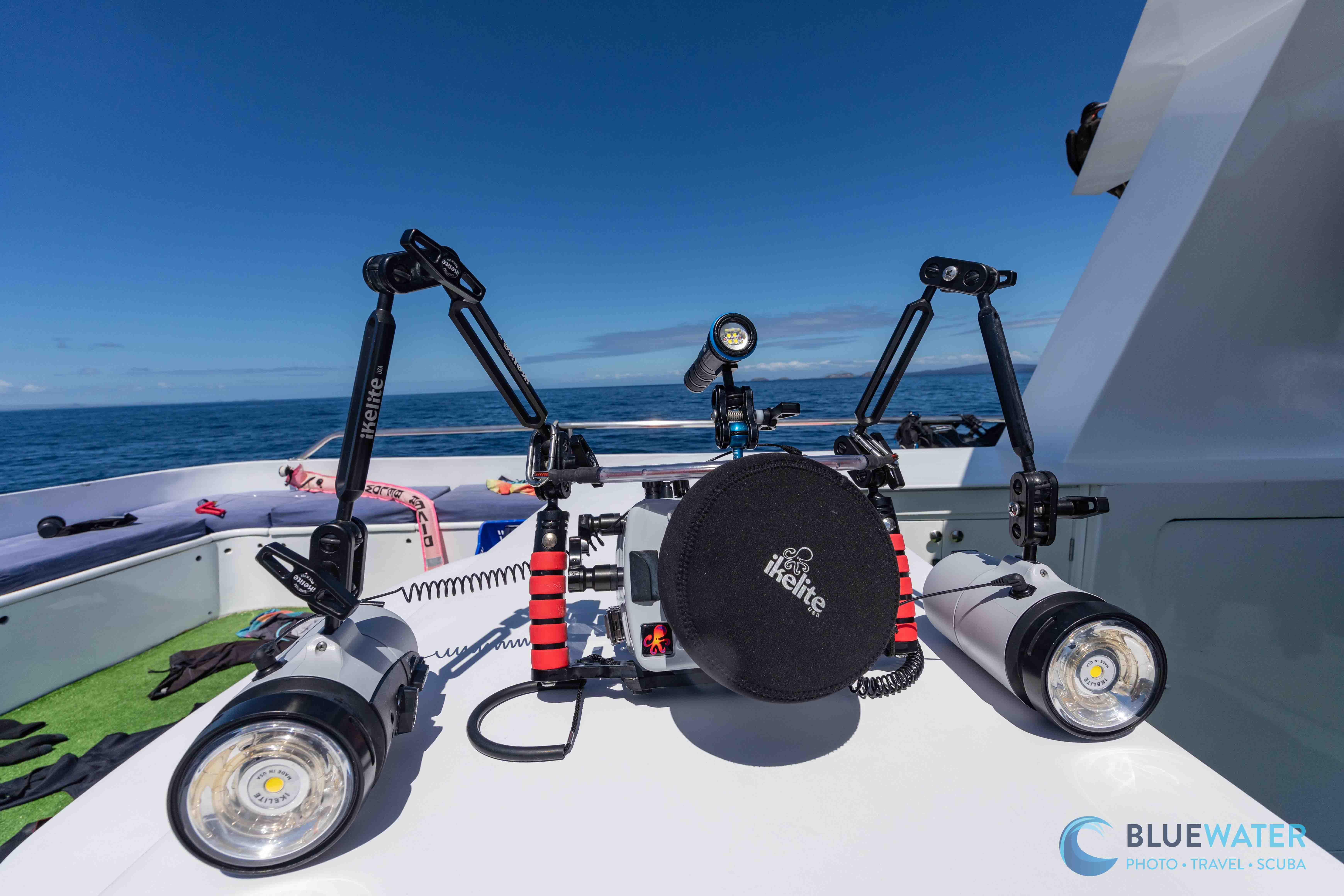
The Canon EOS R6 Mark III in the Field in the Galapagos in an Ikelite Housing with Dual Ikelite DS232 Strobes
I'll say it up front - in the ever increasing "camera arms race" between Canon and Sony, Canon has won the prosumer full frame mirrorless round with the Canon R6 Mark III. Typically, I am brand agnostic and rarely crown a winner. Afterall, there are so many elements to consider on a personal level when choosing a camera and a brand. You have lens repertoire, video features, resolution, low light performance, etc. Each camera needs to be custom-fit to the user for their own use cases. And that's what we do at Bluewater Photo - we find the right camera to fit the right customer and lay out exactly what they need for their next shoot.
But in the case of the Canon EOS R6 Mark III, currently retailing for $2,799, the recently released Sony A7V prosumer model just doesn't compete for underwater photography and particularly for underwater video. I've been fortunate enough to take both the Sony a7V and the Canon R6 Mark III diving as soon as their housings were released by Ikelite in order to test the differences underwater. You can read my review of the Sony a7V here, where I was able to dive with it in the cold, winter waters of the Pacific Northwest. But now that summer is around the corner, I had the opportunity to test the Canon EOS R6 Mark III in the Galapagos with the new Canon 7-14mm fisheye lens, the new Ikelite housing, and the new Ikelite DS232 strobes. On this Bluewater Travel underwater photography workshop, we had the chance to try our luck photographing unique endemic critters like marine iguanas, blue lined nudibranchs, dozens of sea turtles, and parrotfish. You can read the full trip report here. But more importantly, I got to put the R6 III to its limits of autofocus, video performance, and low light performance as you can see in this full underwater review.
Jump to a Section

Purchase a Canon EOS R6 Mark III underwater housing at Bluewater Photo and Scuba:
Ikelite Canon R6 III Underwater Housing
Marelux Canon R6 Mark III Underwater Housing
Nauticam Canon R6 Mark III Underwater Housing
Inon X-2 R6 III Underwater Housing for Canon EOS R6 Mark III
Check out our full Canon R6 III Underwater Hosuing Buyer's Guide.
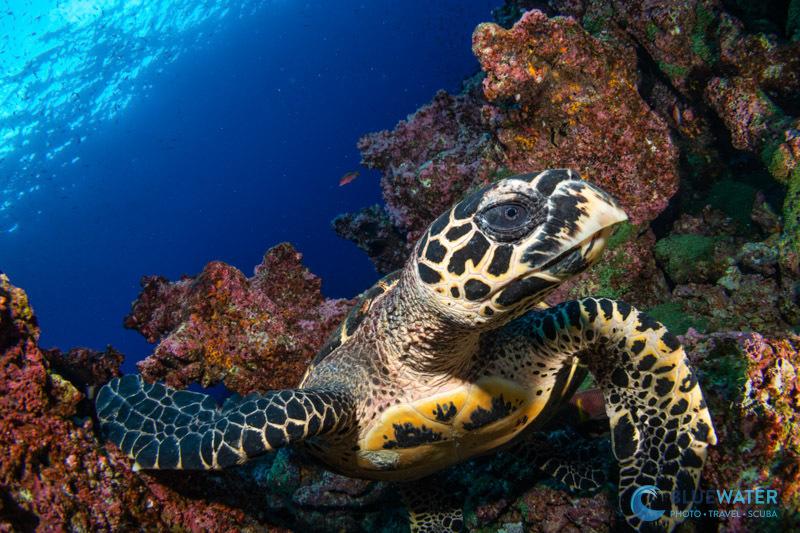
A hawksbill sea turtle photographed with the Canon EOS R6 Mark III in an Ikelite housing with the Canon 7-14mm fisheye lens. f/13, 1/100, ISO 320
Key Canon EOS R6 Mark III Specifications
- 32.5 megapixel full frame sensor
- 40 fps burst shooting with electronic shutter and 12 fps burst shooting with mechanical shutter
- Dual Pixel II autofocus system with subject tracking
- Up to 8.5 stops of in body image stabilization
- CFexpress B and UHS-II SD card slots
- Up to 7K/60p RAW video recording (open gate)
- Up to 4K/120p video recording
- Digic X image processor
- RF lens mount (EF lenses with EF-EOS R adapter)
- Low light autofocus down to -6.5 EV
- 3.69 million dot EVF
- 1/250 flash sync speed with electronic first curtain shutter, 1/200 flash sync speed with full mechanical shutter
- Weight: 699 grams with card and battery
- Dimensions: 138.4 x 98.4 x 88.4 mm
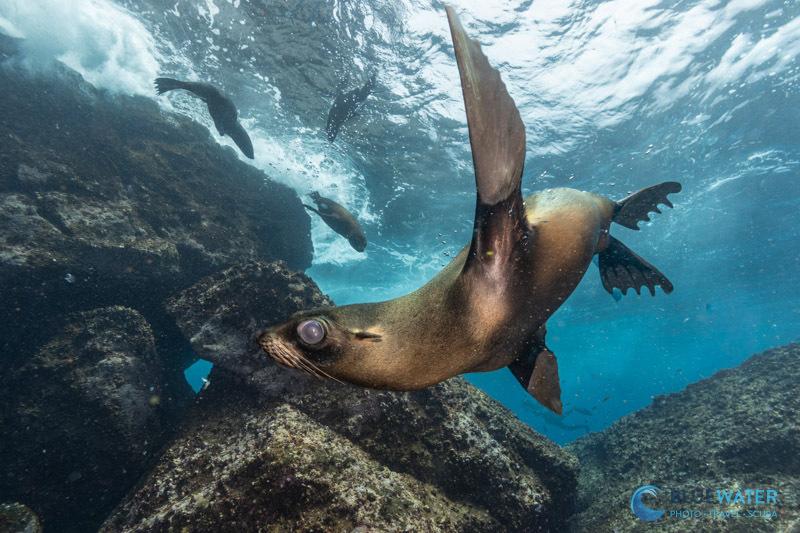
A juvenile Galapagos sea lion photographed with the Canon EOS R6 Mark III camera
Key Features for Underwater Photography
By many standards, the Canon EOS R6 Mark III is more than enough for most professional underwater shooters. So there's a lot to talk about. Thankfully, we have a full underwater settings guide for the camera. But there are also a few key features that stand out in the R6 Mark III.
Better Image Quality with a New Higher Resolution Sensor
The first is the upgraded image sensor. The R6 III has a new 32.5 "higher" resolution full-frame sensor. It's up from 24.5 megapixels in the Canon R6 Mark II. And while the R6 III doesn't have quite the resolution of the Canon R5 Mark II, I barely noticed a difference. In all of my macro shots, I was able to crop quite a bit and still have excellent image quality. It helps that each RF mount lens is extremely sharp - especially the RF100mm macro that I was shooting.
In my opinion, 32 megapixels of resolution is the sweet spot for a full frame sensor. It allows for reduced noise in low light while still providing enough detail to crop. This makes the R6 Mark III and excellent camera for astro photography but also an excellent camera low light conditions. This was particularly useful in the Pacific Northwest where I used the R6 Mark III to photograph an octopus in less than 10 feet of visibility. I was able to increase my ISO to 1600 with minimal noise and capture very nice, clean images.
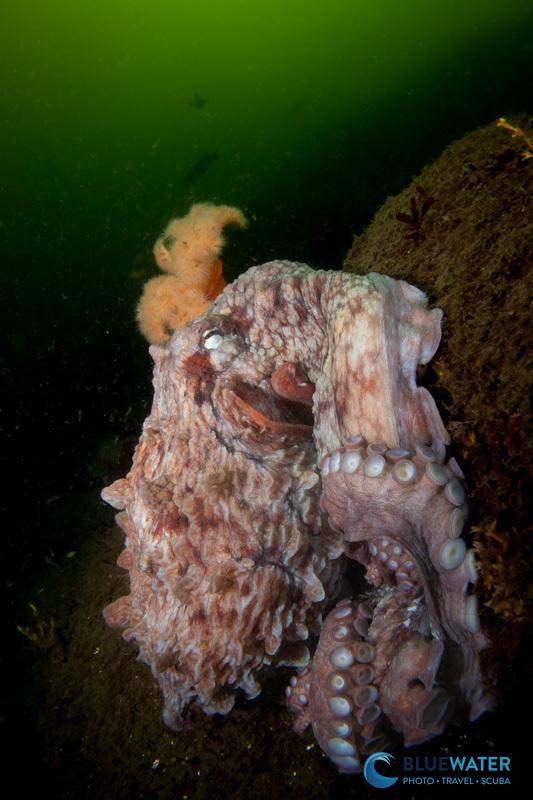
A lowlight image of a giant pacific octopus capture in less than 10 ft of visibility in the Pacific Northwest with the Canon EOS R6 Mark III. f/11, 1/40, ISO 1000
Ultrafast Burst Shooting
Canon was able to increase the R6 III's resolution while maintaining its lightning-fast burst shooting rate of 40 fps with the electronic shutter and 12 fps with the mechanical shutter. Being a more traditional underwater photographer who uses strobes, I really don't need much more speed in my shooting than 5-10 fps because I'm limited by most strobes - though the DS232s are quite fast! So I didn't take full advtage of the feature.
That said, many pelagic and ambient light photographers will welcome the ability to capture quick action with RAW burst rates faster than many videos!
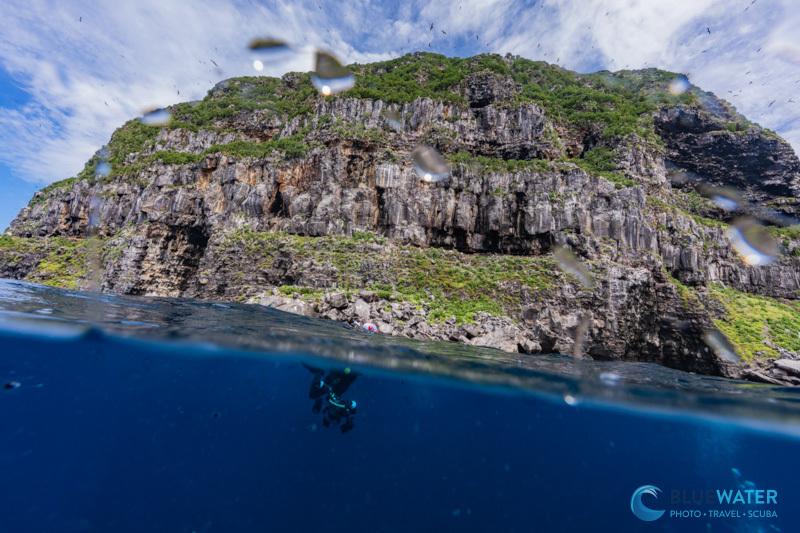
Quick burst rates can help capture split shots using a smaller dome with the Canon R6 Mark III and the 7-14mm fisheye lens
In Body Image Stabilization
On the flip side, if you need a slow and steady shot, the Canon R6 III has you covered. As with other Canon full-frame cameras, the in-body image stabilization is excellent. It can correct for up to 8.5 stops of exposure with an image stabilized lens. In practical terms, this means that you can shoot at very slow shutter speeds and not get any motion blur. You can see this in action in my octopus photo above where I was shooting at 1/40th of a second.
For video shooters, it makes hand held video much easier - especially hand help macro video. Combined with 4K/120p recording, who needs a tripod?
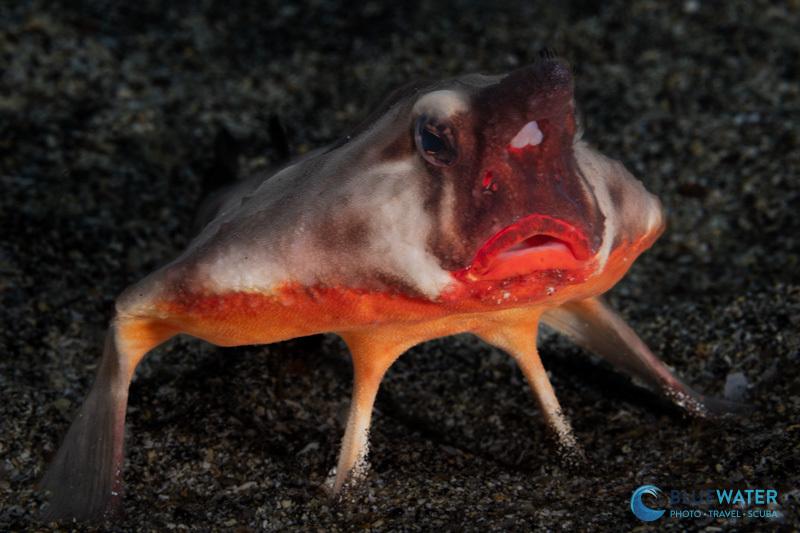
Macro photography and video can be made a bit easier with in body image stabilization. This unique and endemic red lipped batfish was captured with the Canon EOS R6 Mark III and the Canon RF 100mm macro lens
Dual Pixel II Autofocus
With most modern full-frame cameras, you can't really go wrong when it comes to autofocus. Dual pixel II autofocus tracking with the R6 Mark III is excellent and about 90% of my shots were in focus - even with the quick action and currents in the Galapagos. I did notice that the camera back-focused on a few of my shots (the other 10%), but the internet assures me that it's a "me" problem.
Subject recognition does work relatively well with the R6 Mark III. The camera has an easier time identifying and tracking fish eyes with a macro lens.
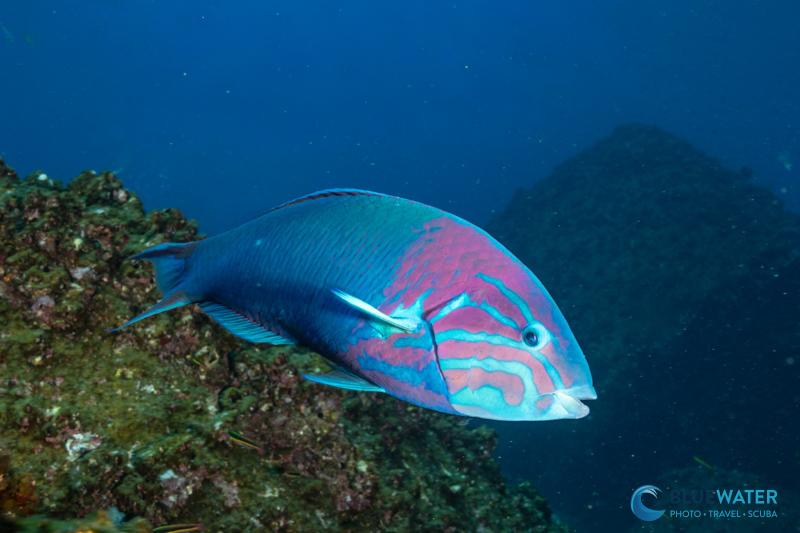
Quick autofocus was essential for photographing a wrasse with the Canon EOS R6 Mark III
Battery Life
The Canon R6 Mark III battery life is 620 shots per charge with the LCD. This is more than enough for any dive day and would actually last me two days of diving if I was too lazy to charge between dive days. The Ikelite USB-C charging bulkhead made it so I didn't need to remove the camera from the housing at all.
Key Features for Underwater Video
The Canon EOS R6 Mark III is a formidable video camera and in many ways the best option for underwater videographers in the Canon line up. It fixes our main gripe that we had about Canon with a new way to set custom white balance! But more importantly, the combination of in body image stabilization, dual pixel autofocus, and 4K/120p & 7K/60p recording makes it a sharp tool to have.
"Open Gate" 7K/60p Video Internal RAW Recording
Higher frame rates and resolutions are beneficial to underwater filmers, but they come with the downside of taking more storage space and processing power. A high frame rate, like 120 fps allows you to slow down your footage in post processing to stabilize it. Many people don't realize they are watching a slow motion underwater video and instead experience it as a stable 3D experience. I usually choose to film at 4K/60p, but the R6 Mark III is also capable of oversampled 4K/120p filming without a crop! This is very useful for quick action and hand held video...especially when combined with 8.5 stops of IBIS correction.
For macro video shooters, the R6 Mark III can film 7K video which can be cropped down to 4K for your final product. This allows for more reach on very small subjects. 7K/60p video is available if you choose to shoot in internally recorded RAW. This file type gives you full control over whitebalance and editing, but is difficult to work with. Otherwise, 7K/30p MP4s can be recorded with C-Log2 and C-Log3. Canon's log profiles are easier to edit for most people's workflows but still provide you with a better color editing experience and capture more dynamic range.
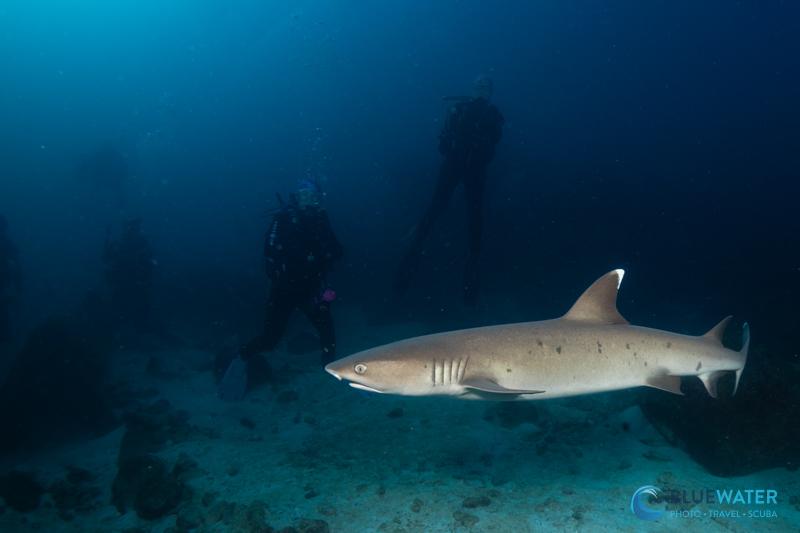
A white tip reef shark swims by divers in the Galapagos - photographed with the Canon EOS R6 Mark III
Canon Has Fixed Their Custom White Balance Issue!
The most important update to the R6 Mark III for underwater video is that Canon has FINALLY fixed their difficult to use custom white balance mode. In the past, with a Canon camera you needed to take a picture of your white balance slate and then assign it in the menu. It was a tedious process that made ambient light video difficult.
Now, the R6 III works the same as Sony and Nikon camera. You can select white balance in the Q menu or with a custom button and then line up the provided "square" with your slate and select it. It's an easy two step process. It's a very exciting improvement for video shooters and warrants serious consideration for an upgrade to the R6 III.
Canon EOS R6 Mark III vs Sony A7V
The Canon EOS R6 Mark III, Sony A7V, and to an extent, the Nikon Z6 Mark III all sit in the same full-frame prosumer camera category. The Sony A7V and the Canon EOS R6 Mark III are the most recent of the two and have the most extensive features. Therefor, most photographers and video shooters looking to upgrade from APS-C and compact cameras will be looking at the these cameras. With Canon's 7K/60p RAW video capability, updated white balance selection, updated resolution, and excellent set of underwater lenses (particularly the new Canon 7-14mm fisheye lens), the R6 III edges out the Sony a7V as the top prosumer camera on the market. The Sony A7V offers 4K/120p video (with a crop), 33 megapixels of resolution, and slightly better autofocus than the Canon R6 Mark III. If you are a Sony shooter and have invested in the glass - the difference to most shooters isn't really noticeable. But there is a clear benefit to choosing the Canon R6 III if you have not invested in your lenses.
Is the R6 Mark III Worth the Upgrade?
At this point, we can confidently say that the Canon EOS R6 Mark III is worth an upgrade. If you are an old R6 or R6 II shooter, you'll have significantly better video features and more resolution. If you are an APS-C shooter (like the R7, R10, or R100), the R6 Mark III presents a formidable imrovement in dynamic range and video features. As it stands, with the custom white balance fix, the Canon R6 Mark III is my favorite Canon camera for underwater video. I do hope that the Canon R5 II will be upgraded in the future with a firmware update fixing this feature.
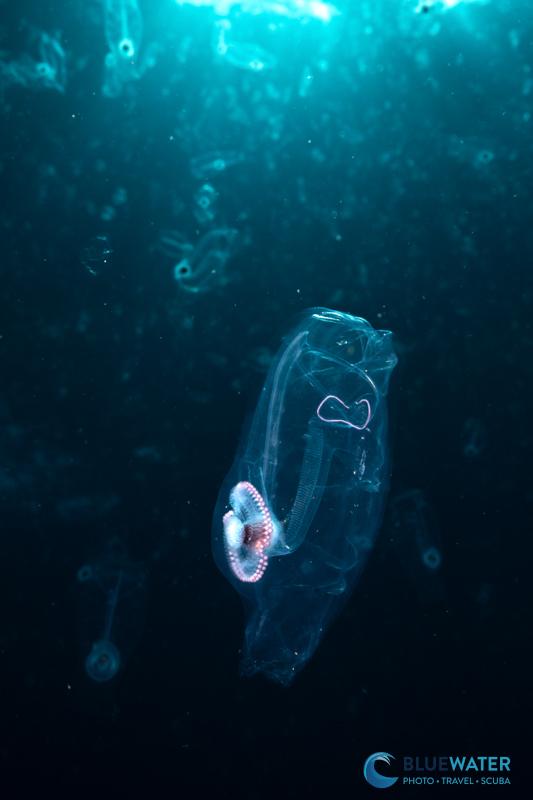
A salp photographed with the Canon EOS R6 Mark III and the Canon RF 14-35mm lens
Canon R6 Mark III Underwater Housings
Currently Ikelite, Inon, Marelux, and Nauticam all have housings available for the Canon EOS R6 Mark III. You can see them all listed in our full underwater housing guide for the R6 III. For this review, Ikelite let me borrow their prototype Canon EOS R6 Mark III housing. I was thoroughly impressed with their updated dials, excellent back button focus and trigger system, and full access to controls. But I wanted to give a special shoutout to their new external TTL trigger for the Canon EOS R6 Mark III. It's only compatible with Ikelite strobes and I used it with the Ikelite DS232 RC fiber optic strobes. This TTL system is the most accurate fiber optic based TTL that I have ever used. Almost every shot was spot on and I ended up leaving my strobes lazily in TTL the whole trip so that I could focus on composition. It paid off!
If you are considering anodized aluminum housing options, it's worth taking a look at the Inon housing for the R6 III which allows for a magnetic control ring of lenses as well as a quick release to switch from horizontal to vertical shooting. The Marelux Canon R6 III housing is very lightweight underwater and has a larger port opening so that you can load most lenses from the back without taking the port off! The Nauticam R6 III has compatibility with their popular optics.
The Ikelite TTL trigger did an excellent job getting proper exposure from my Ikelite DS232 strobes so that I could focus on composition
Canon R6 Mark III Underwater Lenses
Macro
Macro lenses are necessary to capture photos of small underwater creatures – usually the size of a golf ball or less.
Canon RF 100mm f/2.8L Macro IS USM: This is the best macro lens for small and shy subjects due to a larger working distance. It’s also an essential tool for supermacro photography when combined with a macro diopter. The Canon RF 100mm macro is a superior lens compared to the EF version because is has an additional magnification and can capture photos at a supermacro 1.4:1 ratio. The Canon RF 100mm is also equipped with a spherical aberration control ring, which we don’t recommend for underwater use as it creates a soft look.
Canon EF 100mm f/2.8L Macro IS (with EF-EOS R Adapter): This is a great macro lens for small and shy subjects due to a larger working distance. It’s also an essential tool for supermacro photography when combined with a macro diopter.
Canon RF 85mm f/2.8 Macro Lens: On paper the Canon RF 85mm macro lens looks like a great option for an affordable price. But its autofocus is almost unusable underwater due to the extremely slow moving focusing barrel.
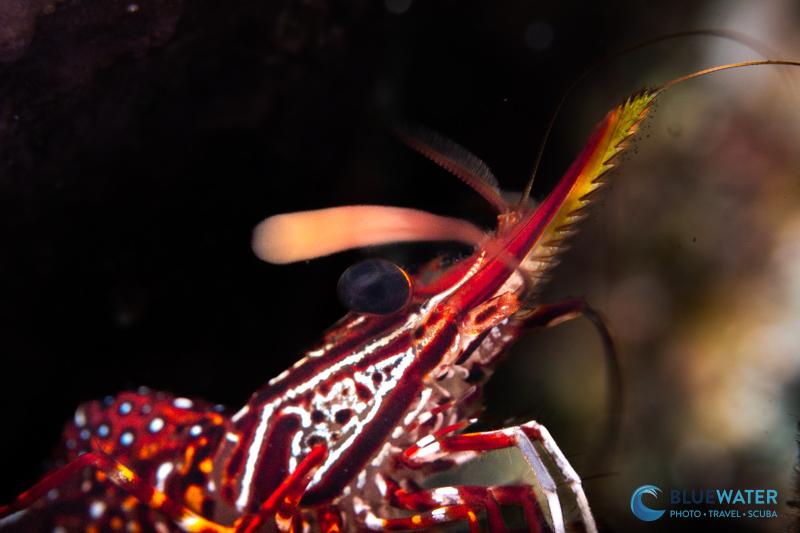
A macro photo captured with the Canon EOS R6 Mark III and the Canon RF 100mm macro lens
Recommended Wet Diopters
Nauticam Super Macro Converter: The Nauticam super macro converter (SMC-3) is a wet diopter that can help capture sharp macro and super macro images. It’s one of the strongest, sharpest diopter on the market. If you are a super macro photographer, this diopter is best used with the Canon 100 mm f/2.8 macro.
Kraken +13 Diopter and Weefine +13 Diopter: Both of these diopters are equal to the Nauticam SMC in quality for a more affordable price. They are excellent supermacro options that are not too difficult to use but still have incredible magnification. For the most super macro of diopters, we recommend the Kraken +23 and the Weefine +23 but they can be the most difficult to use.
Bluewater +7 Diopter: The Bluewater +7 is our recommended diopter for beginner underwater photographers. While not as much magnification as the rest on this list, it pairs well with mid-range “kit” lenses as well as the Canon 100mm macro for additional magnification.
Read our full guide to underwater macro wet lenses
Wide Angle Fisheye
Wide angle fisheye lenses allow for an ultra-wide field of view. Unlike rectilinear wide angle lenses, they are able to focus much closer to the subject but can result in barrel distortion in the corners of the image. The distortion is reduced underwater to the angle of refraction of light through the water.
Canon RF 7-14mm f/2.8-3.5 circular fisheye lens: This is Canon's newest fisheye lens for the RF mount and the lens that I took most of my photos with for this review. It's a nice upgrade over the Canon EF 8-15mm fisheye with a slightly wider 190 degree field of view. Zoom into 15mm and you have a nice wide angle image. At 8mm you get a circular fisheye look.
Canon EF 8-15mm f/4L circular fisheye (with EF-EOS R Adapter): This is going to be the best choice for a full-frame fisheye lens. At 8mm, the lens vignettes over itself creating a cool, artistic, circular fisheye affect. For traditional fisheye images, just zoom into 15mm and you will capture beautiful ultra-wide angle shots without vignetting.
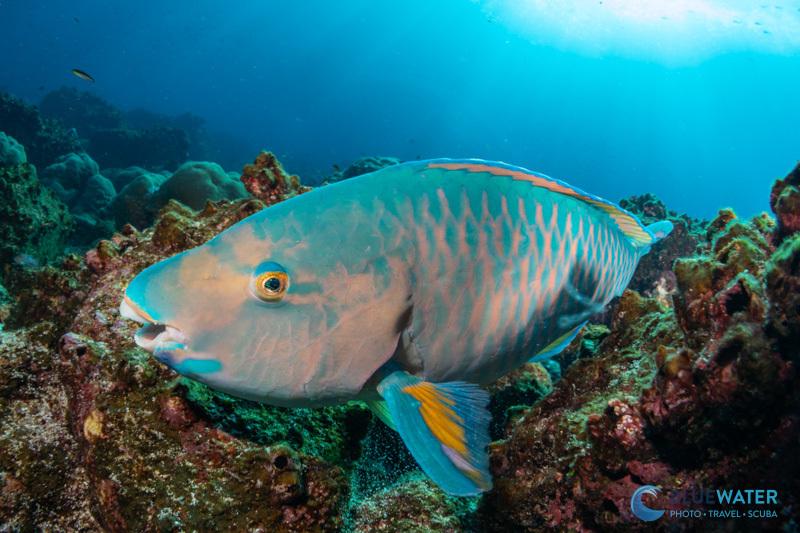
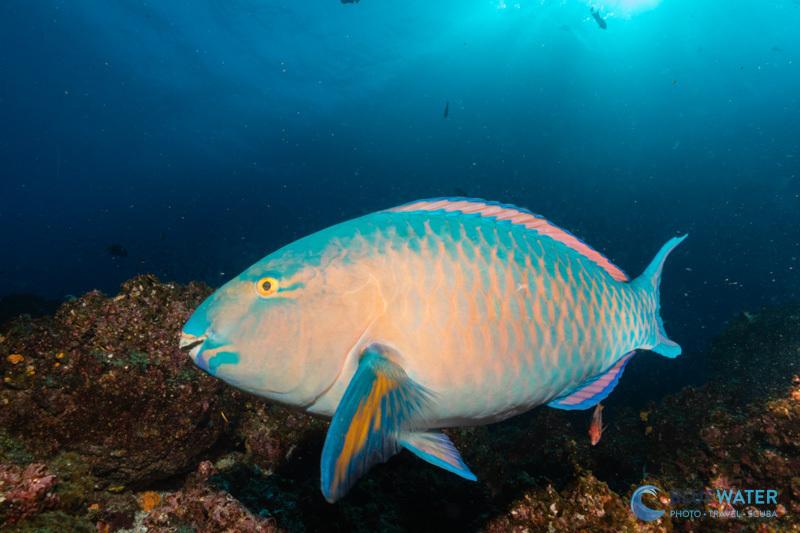
This parrotfish was captured with the Canon RF 7-14mm fisheye lens at 14mm
Rectilinear Wide Angle
Rectilinear wide angle lenses retain a wide field of view but do not exhibit the distortion found on fisheye lenses. They are great for large animals like sharks and reefscapes and they can often zoom closer to the subject.
Canon RF 14-35mm f/4 L IS USM: This lens is our top rectilinear wide angle lens choice for underwater photographers using an EOS R style mirrorless camera. With a reduced flange distance in the RF lens mount, the corner sharpness produced by the RF 14-35mm is incredible for a rectilinear lens. That being said, be aware that this lens produces vignetting at 14 mm. Plan on using this lens as a “16-35mm” equivalent. Most underwater shooters use rectilinear wide-angle lenses for shooting subjects that don’t come close enough to fill the frame with a wide fisheye lens: sharks, whales, sea lions, dolphins, etc.
Canon EF 16-35 f/2.8 III Ultra-Wide Zoom lens (with EF-EOS R Adapter): This lens is the a great choice for those who are buying their first wide-angle lens and don’t have a strict budget. Most underwater shooters use rectilinear wide-angle lenses for shooting subjects that don’t come close enough to fill the frame with a wide fisheye lens: sharks, whales, sea lions, dolphins, etc.
Canon EF 16-35mm f/2.8L II Wide-Angle Lens (with EF-EOS R Adapter): This has been the most popular rectilinear wide-angle lens for Canon full frame. This lens sat at the top of the selection for the last few years in terms of corner sharpness, speed, and price… although that will change as more new shooters purchase the version III.
Canon EF 11-24mm f/4L Ultra Wide-Angle Lens (with EF-EOS R Adapter): Want the widest lens you can buy? The Canon 11-24mm offers a much wider field of view than the 16mm. This perspective is great for reefscapes, massive wrecks and very wide shots where you do not want the distortion of a fisheye lens. The downside is that this lens is larger, heavier and more expensive than the other wide-angle lens choices.
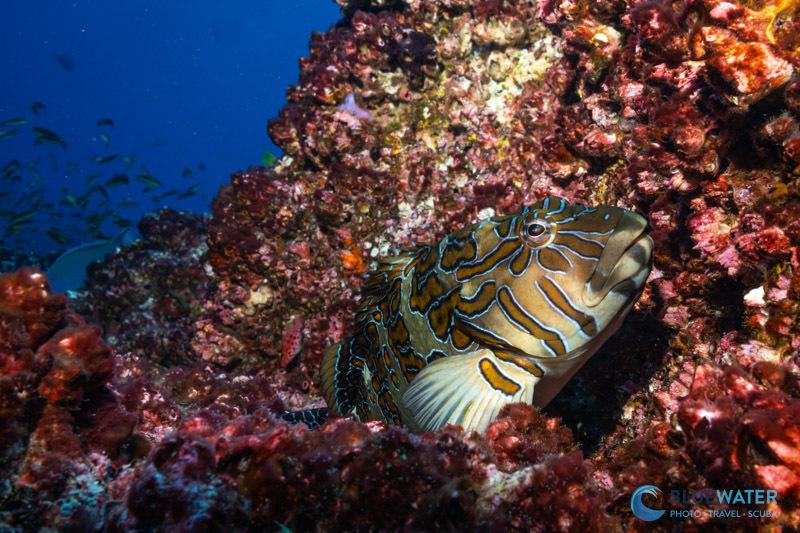
The Canon RF 14-35mm rectilinear wide lens allows for a little bit more zoom. Captured with the Canon EOS R6 Mark III
Conclusions
The Canon EOS R6 Mark III is one of the most exciting cameras that Canon has released in a long time, and after diving with it, I think it is the best prosumer full-frame camera currently available for underwater shooters. That doesn’t mean it is the right camera for everyone. If you already have a Sony system with a full set of lenses, ports, and housing accessories, then it probably does not make sense to sell everything and switch. Modern cameras are so good that the differences are often smaller than people on the internet make them sound.
But if you are buying into a new full-frame system, or upgrading from an older Canon body, the R6 Mark III is very hard to beat. The 32.5 megapixel sensor gives you a really nice balance of resolution and low light performance. The autofocus is fast and reliable, the burst shooting is almost overkill for most underwater photography, and the image stabilization makes both stills and video easier to capture in real dive conditions.
Where the R6 Mark III really stands out is video. The combination of 4K/120p, 7K RAW recording, 7K open gate MP4, Canon Log 2, Canon Log 3, and excellent in-body stabilization makes this a serious underwater video camera. But the most important improvement for underwater shooters is the new custom white balance workflow. It finally feels like Canon understood what underwater videographers actually need in the water. Being able to set custom white balance quickly and easily makes a real difference when you are changing depth, filming ambient light scenes, or trying to capture accurate color without wasting half the dive in the menu.
The Sony A7V is still a great camera, and Sony still has a strong lens ecosystem and excellent autofocus. But for underwater use, the Canon R6 Mark III feels like the more complete tool. The video specs are stronger, the custom white balance workflow is better, and Canon’s RF lens options — especially with the new RF 7-14mm fisheye — make a lot of sense underwater.
So yes, I think Canon has finally overtaken Sony in this specific category. Not for every photographer, and not in every situation. But for the full-frame prosumer underwater shooter who wants one camera for high quality stills and serious video, the Canon EOS R6 Mark III is now my top choice.
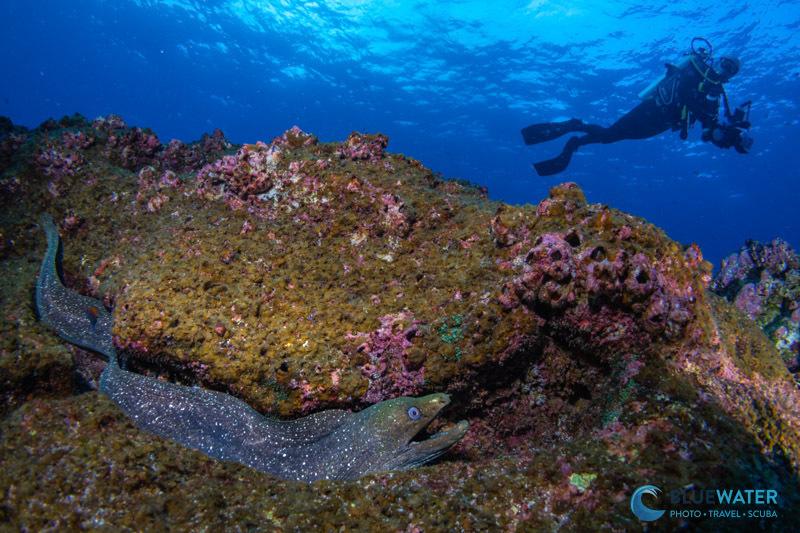
An eel and diver at Darwin Island, Galapagos photographed with the Canon EOS R6 Mark III

Nirupam Nigam
Nirupam Nigam, the President of Bluewater Photo & Scuba, is an accomplished underwater photographer and fisheries scientist with a deep-rooted passion for marine life. He began his journey in underwater photography at 15 and, by age 22, became the Editor-in-Chief of uwphotographyguide.com, the leading online resource for underwater photographers. As a North Pacific and West Coast Fisheries Observer, Nirupam spends months aboard fishing vessels in remote areas such as the Bering Sea and Gulf of Alaska, collecting critical fisheries data for the U.S. government. He hails from the West Coast, considering both Southern California and Western Washington home.