Ikelite Ecko Strobe Review
Posted by Nirupam Nigam on October 4th, 2025
Over the summer of 2025, Ikelite surprised with two new strobes - the prosumer Ikelite DS 165 and the entry level Ikelite Ecko Strobe. The Ecko replaces the DS 51 II which was a popular choice for compact camera shooters and new photographers. The new Ecko maintains an excellent price point of $495 with significant upgrades, including a wider beam angle, a cooler color temperature, built-in RC TTL (automatic strobe power for Olympus cameras), and a fiber optic version of the strobe that no longer requires a fiber optic adapter.
Our staff at Bluewater Photo were some of the first to dive with this awesome little strobe - here in the west coast of the United States. Cold, dark waters are some of the most ideal dive conditions for a 50 Ws strobe as you don't need an insane amount of light like you sometimes do in clear, shallow water (which the DS 165 is better suited for). We were able to capture spectacular wide angle and macro images, though the strobe is better suited for macro photography. On low-viz summer days, our images of wolf eels, rockfish, and anemones, turned out splendidly with our OM System TG-7 camera. The RC TTL mode (automatic strobe power) was built into the strobe and allowed us to not worry about our strobe power setting while diving with these skittish fish.

Ikelite Ecko Strobe in the Field
Ikelite Ecko Strobe Key Specifications
- Power: 50 Ws - a decent power level for a macro strobe
- Beam Angle: 120 degrees (wider with the included dome diffuser)
- Color temperature: 5700K
- Trigger Options: Fiber optic version or electrical bulkhead (DS) version
- AA battery powered, sealed battery compartment
- Depth rating: 100m/330 ft
- RC TTL and TTL modes
- 2.5 second recycle time at full power
- Weight: 391 grams
- Dimensions: 83mm x 105mm
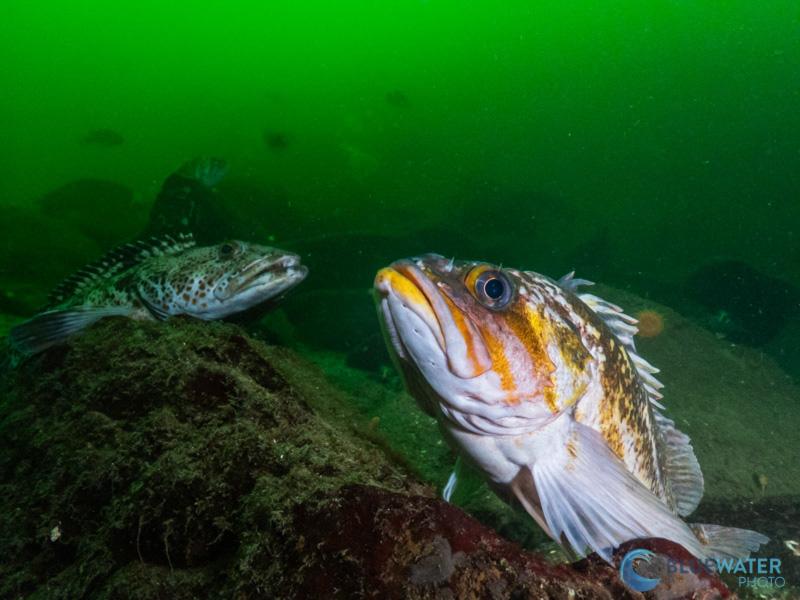
A rockfish and lingcod exposed perfectly with RC TTL captured with the OM System TG-7 and Ikelite Ecko Fiber Strobe
What's New With the Ikelite Ecko Strobe?
The Ikelite Ecko is equipped with some serious updates when compared to its popular predecessor - the Ikelite DS51 Mark II. The Ecko's recycle time is a full second faster at 2.5 seconds at full power. While this isn't as fast as a pro-strobe, it's a significant improvment over the DS51. Likewise, the new circular flash tube on the strobe promises a wider beam angle and a more even spread than the square flash tube on the DS51. Finally, the color temperature is a little cooler than the DS51 which can be preferred for greener water environments.
RC vs DS: Choose the Right Strobe for Your Rig
With the announcement of the Ecko strobes, Ikelite introduced two different strobe bulkheads (connection points) for the first time. There is a fiber optic version of the strobe that plugs in straight to your fiber optic cables. There is also an electronic bulkhead (DS) version of the strobe if you want to use wired sync cords. Functionally, the flash head, power, and beam are the same and they both can use TTL and RC TTL.

Close up of a wolfeel captured with two Ikelite Ecko Strobes
Field Conditions and Test Setup:
- Location: Pacific Northwest cold-water reef
- Conditions: low summer visibility, lots of particulate
- Subjects: fast rockfish and lingcod, darting into and out of kelp
- Lenses used: WD-3 wet dome for wide-angle; Microscope mode for macro
- Triggering: RC TTL via fiber-optic
My goal was to see whether the Ecko could keep up when subjects move, backgrounds change, and you don’t have time to fine-tune exposure between shots.

Performance & Real-World Results
Coverage & Lighting Quality
The new Ecko diffusers have a unique checkered pattern and I found that they produced smooth, even light across wide scenes. The strobes certainly live up to their 120-degree beam angle specification. I did not observe any harsh hotspots or abrupt falloff edges - even in frame corners. Against the DS51 II, the Ecko consistently gave wider, cleaner illumination across my wide-angle shots that I captured with the WD-3 wet dome. In cold-water settings, the strobe was plenty powerful, but in bright tropical sunlight, you might feel its limits in the shallows.

Rockfish Photographed with the Ikelite Ecko Strobes in RC TTL mode
TTL Consistency
Using the TG-7 in RC TTL mode, the strobe gave me shot-to-shot exposure stability that I could rely on. Now, in the hazy summer conditions, it wasn't exactly the same between shots, but it certainly beat changing power settings manually. When a fish swam closer or farther, the strobe adjusted itself without me having to ride the dial.

RC TTL did a great job with wide angle anemone scenes
Manual Control & Dial Feel
I'll be honest - the dials on the Ikelite Ecko strobes are stiff. Underwater, I had to turn them intentionally. It's unlikely that you'll bump settings by accident, which is good, but it's easy to mistake the battery compartment for the power dial. Be careful! Even in thick cold water gloves, I managed to adjust settings, but I always double-checked what I was rotating more than once.

Recycle Speeds
I used four AA Eneloop Pro NiMH batteries. In my tests, the recycle time was never a limiting factor - the TG-7's recycle time usually was slower than the strobe itself. While the recycle time of 2.5 seconds is not an elite speed, value for money, it's quite acceptable. In fact, there are some flagship GN40 strobes out there that have a 2 second recycle time!

Pros and Cons (From Real Dives)
Pros
- Beam coverage is wider and more even than many strobes in this class
- TTL in RC mode is stable and usable under less-than-ideal conditions
- Dome diffusers help smooth out spread without hotspots
- AA battery power makes spares easy and travel-friendly
- Build and sealing hold up in cold, real-water use
Cons
- Stiff control dials—precise, but requires deliberate motion
- Not powerful enough for huge reef walls or long-distance lighting in bright water
Who Should Use the Ecko Strobes
This strobe is ideal for newer, macro, or intermediate underwater photographers using compacts or mirrorless setups who want a travel-capable, dependable lighting solution. If your dives often involve moderate distances, fast-moving subjects, and ambient drop-off, the Ecko keeps you in the game without being burdensome. But if your work demands blazing outputs on big walls or deep blue reef-scapes, you’ll eventually want something more robust.

Final Verdict
For my cold-water test dives, the Ikelite Ecko delivered. It pulled off wide coverage, reliable TTL, and a clean beam. It’s not a pro-grade powerhouse—but in its class and price range, it beats expectations. Use it wisely, understand its limits, and you’ll come home with keepers more often than you expect.