
Marelux Mirage 20 Multiflash Generator Review
Posted by Nirupam Nigam on October 31st, 2026
As Halloween quickly approaches, we thought it would be fun to review one of the spookiest underwater photo gadgets in 2026 - the Marelux Mirage 20 Multiflash Generator. It represents a fun alternative to double exposure compositions for quick-moving subjects. In many ways, the Marelux Mirage 20 is the first underwater stroboscopic device. It converts a single optical trigger signal from your camera flash or flash trigger into a rapid series of signals, allowing your strobes to fire multiple times during a single long exposure. The resulting effect is multiple flash exposures of the same subject in one photo.
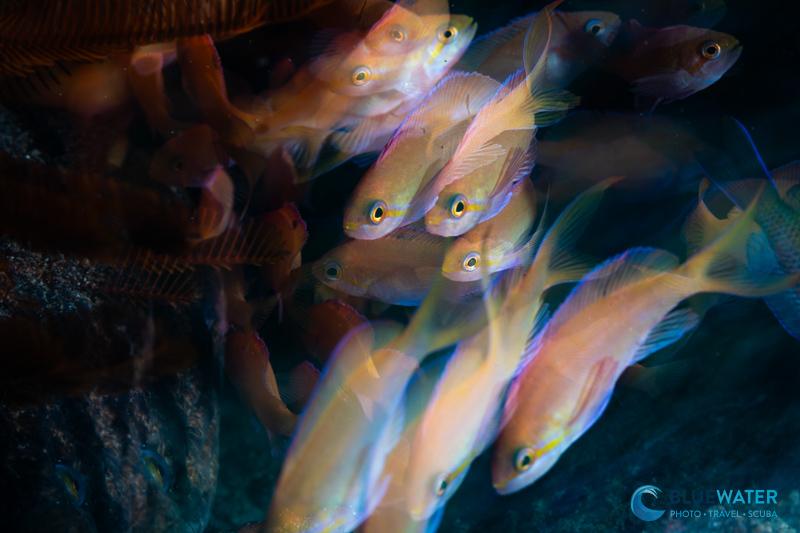
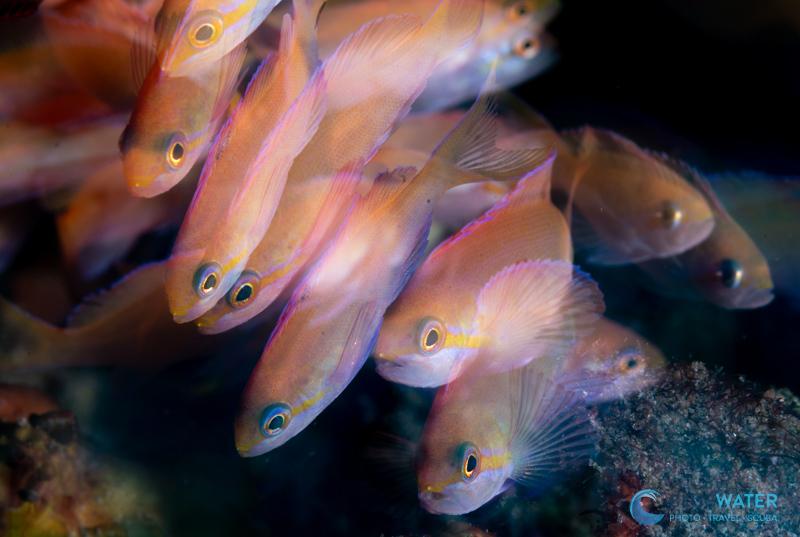
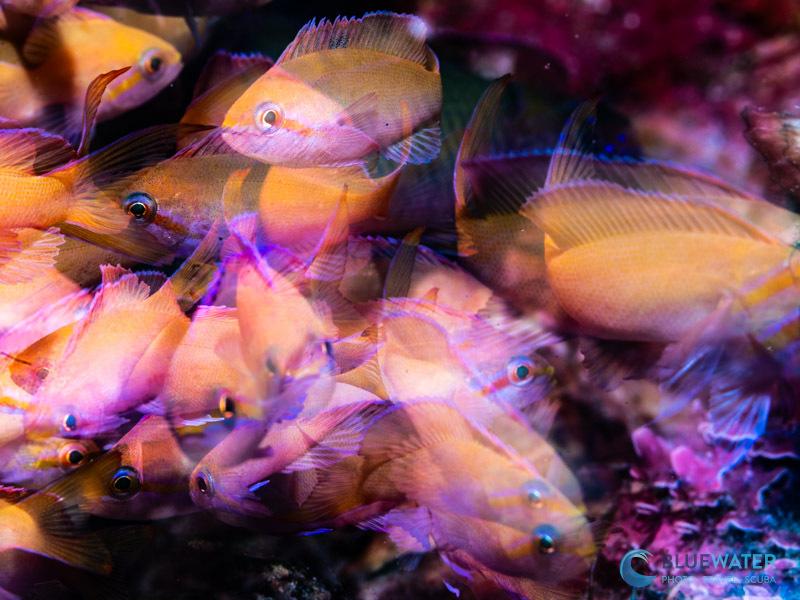
A School of Anthias Photographed with the Marelux Mirage Multiflash Generator, Marelux Apollo S strobes, and a Nikon Z8 in a Marelux Housing
At $350 for the retail price, the anodized aluminum gadget mounts just above your housing's fiber optic port or can be attached to the fiber optic port via a fiber optic cable and mounted via a ball mount (non marelux housings). Both of your strobes can connect directly to the Mirage's fiber optic ports via fiber optic cable. The Marelux Mirage can be programmed to trigger for a specific number of flashes and at a speed measured in flashes per second. The three button controls give you the creative freedom to do this, even underwater. The Mirage is depth rated to 100 meters and powered by a 10440 battery.

I had the opportunity to dive with the Marelux Mirage with the Bluewater Photo team in Sodwana Bay, South Africa. It was a trickier piece of kit than I expected, but a lot of fun when I got the hang of it! The trick is to get the right length for your long exposure and match that with the Hz (speed) and number of triggers on the Mirage. I found that a 1-2 second exposure with about 3 triggers per second worked well for me with the subjects I was photographing.
If you're wondering what Hz means, it's simply the frequency of flashes per second. At 3 Hz, the Mirage tells your strobes to fire three times per second, or once every 0.33 seconds. You can also control the total number of flashes. For example, setting the Mirage to five flashes at 3 Hz would produce five trigger signals over approximately 1.33 seconds, assuming the first flash happens immediately. The frequency determines how far apart your subject appears in each exposure, while the number of flashes determines how many times the subject can be captured in the image.
The main difficulty is that you need to make sure you aren't getting too much ambient light in your photo which can overwhelm the artificial light from your strobes. If it's a bright sunny day like when I was diving, I would recommend finding a subject in an overhang or cave. This worked out very well for me when I was photographing quick moving anthias and slow moving eels. Shooting at night can give you better conditions for easily capturing motion in your subjects.
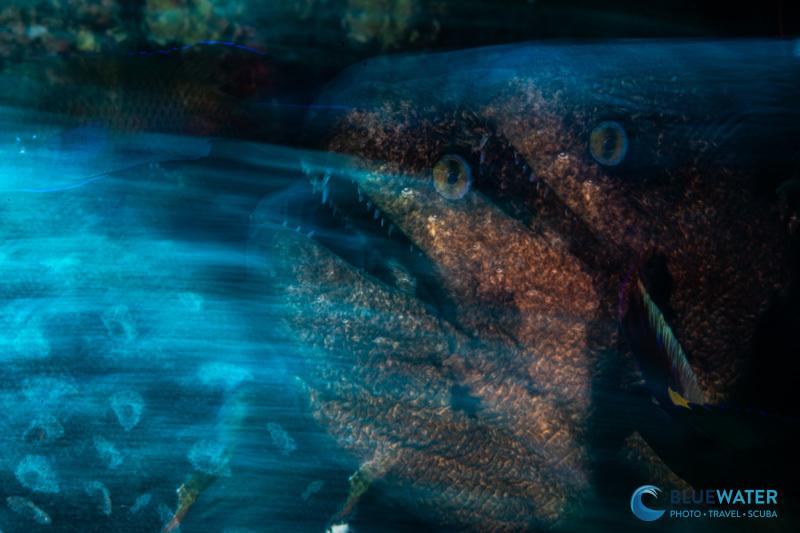
Ambient light can overpower your image, leading to light blue backgrounds, which can be difficult to eliminate on a sunny day. It can also create interesting effects like with this moray eel.
There are a few considerations to make when you have your strobes fire multiple times during a long exposure. The first is that you need a strobe that recycles quickly, like the Marelux Apollo S, Marelux Apollo III 2.0, Sea & Sea YS-D130R, or Ikelite DS230. Even 3 - 5 frames per second can be too quick for many strobes and will result in missed exposures. In order to speed up frame rates, it can be helpful to lower the strobe power. This is a lot easier to do in environments with minimal ambient light.
It's important to think about how quickly your subject is moving as well. It can make sense to increase your frequency (hz) with a couple of test shots to see how the frame freeze matches up with the speed of the subject. Faster subjects might require a quick flash per second rate (and possibly a lower strobe power).
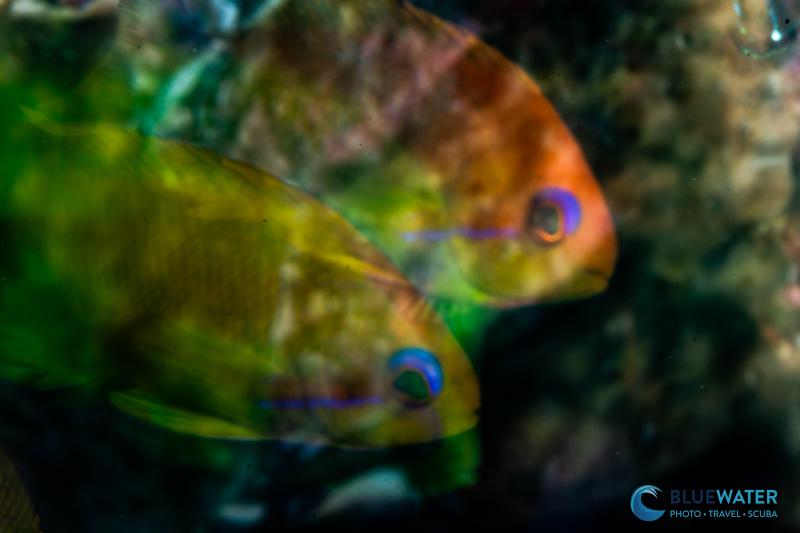
This anthias was photographed with a lower Hz (frequency), which allowed for two succinct frames
In addition to a slow shutter speed, it's important to consider aperture and ISO as well as both settings also affect your exposure. During the day, in high ambient light, I would recommend a smaller aperture (higher f stop). This allows you to get a better exposure with your strobe light. However, it also requires a higher strobe power which can slow down the recycle time, making the Mirage difficult to use. Likewise, I would recommend a low ISO in day time conditions. At night, increasing your ISO and opening your aperture (lower f stop) will allow you to lower your strobe power resulting in a quicker recycle time and more exposures per second.
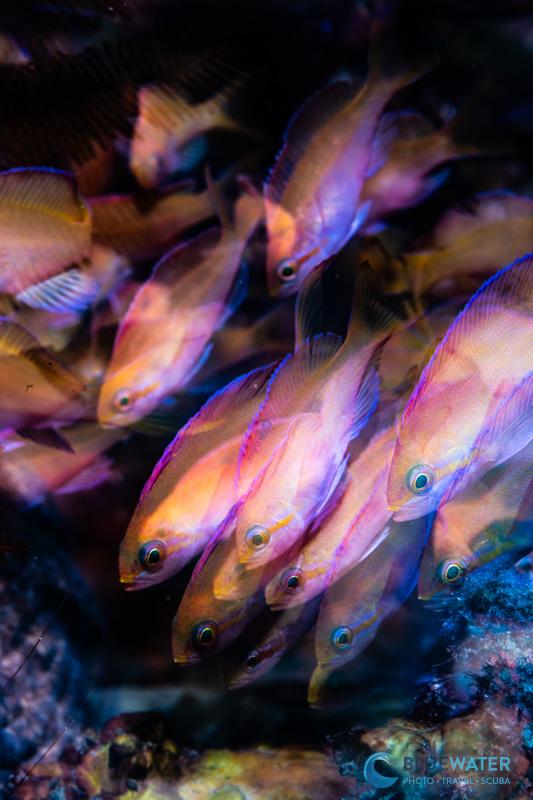
Anthias create interesting, chaotic patterns when using the mirage
If you decide that during a dive you wish to stop using the Mirage and fire your strobes as normal, you can easily switch the device to "normal" mode. While the Mirage still sits between your fiber optic port and your strobe, it will repeat the signal as normal and send it to your strobe. You will not be able to use TTL, but you can fire your strobe in manual mode as normal.
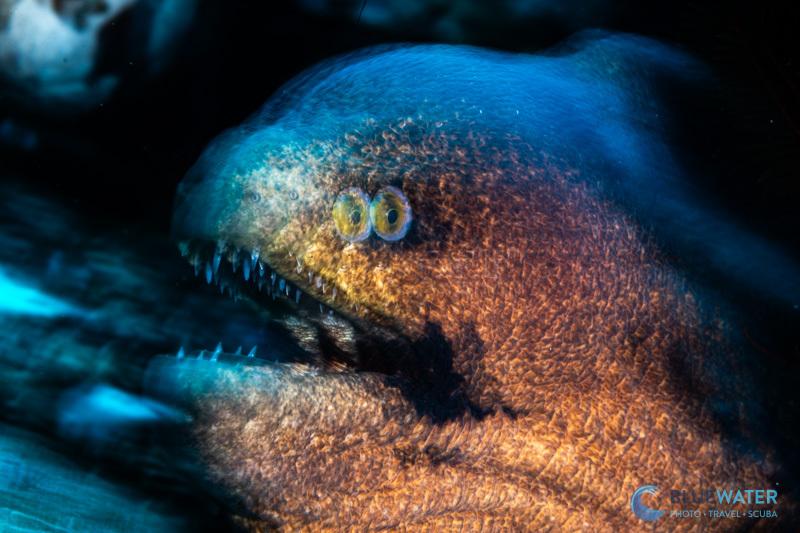
A moray eel photographed with the Marelux Mirage in Sodwana Bay, South Africa
Overall, the Marelux Mirage 20 is one of the more unusual underwater photography accessories I've tested this year. It's certainly not something every underwater photographer needs, but it opens up some interesting creative possibilities that are difficult to achieve with conventional strobe photography. I particularly enjoyed experimenting with moving fish and seeing how different flash frequencies changed the final image.
There is a learning curve, especially when it comes to balancing ambient light, shutter speed, and strobe recycling. It's also the kind of accessory that works better with some subjects and shooting conditions than others. However, once you get the settings dialed in, the results can be a lot of fun.
At $350, I think the Mirage 20 makes the most sense for experienced underwater photographers looking to experiment with something different. It's a specialized creative tool rather than an essential accessory, but that's also what makes it interesting.