What It Takes to Remove 500 Pounds of Ghost Net From a Shipwreck
Posted by Nirupam Nigam on June 8th, 2026
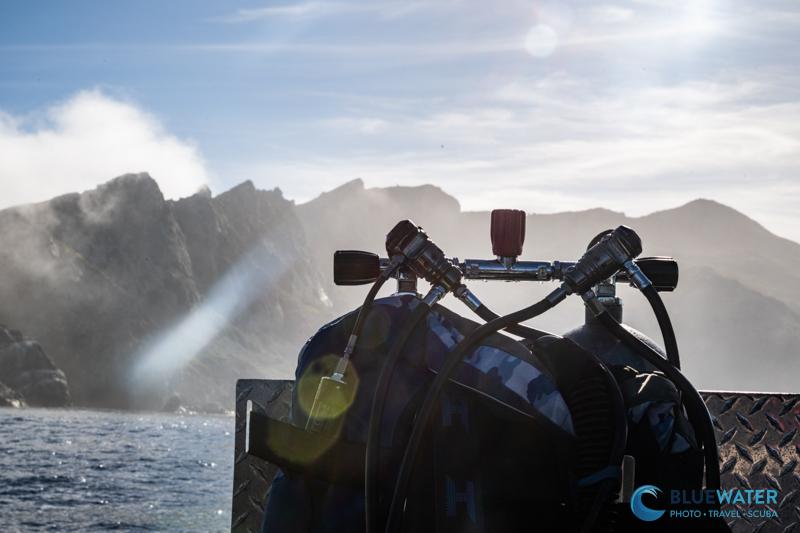
As morning sun burned dense fog from the surface of the cold Californian Pacific, small red balloons began to breach the surface of the water like tiny red icebergs.
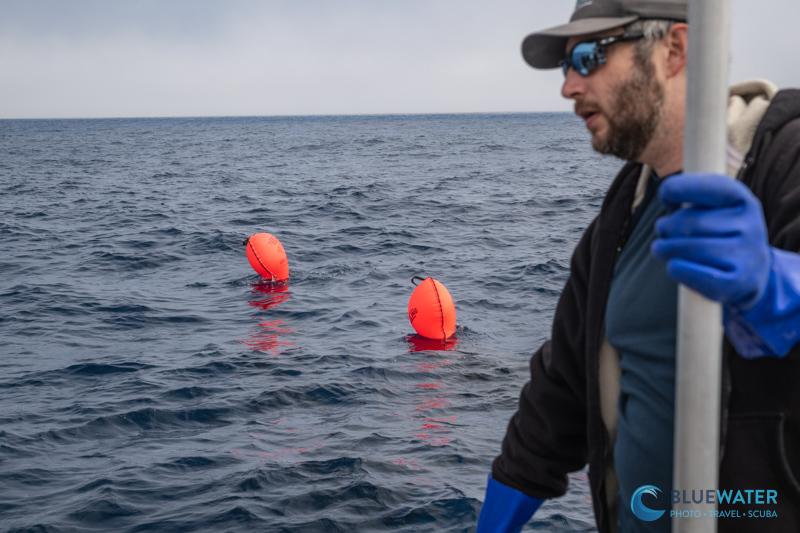
Lift bags appear at the surface of the Pacific after divers 100 ft below tie them to a ghost net and release them - bringing the net to the surface
From the deck of the Giant Stride, we could only see the tops of them floating at the surface. Most of what was underneath was hidden from sight: huge sections of waterlogged purse seine net that a team of technical divers had just cut free from the wreck of the Midnight Hour, more than 100 feet below us.
Curtis headed out in the dinghy to collect the bags before they drifted away. Captain Jim worked diligantly with photographer Daniel to haul net from the dinghy onto the stern of our mothership. One by one, the nets began to pile into a large, smelly mass.
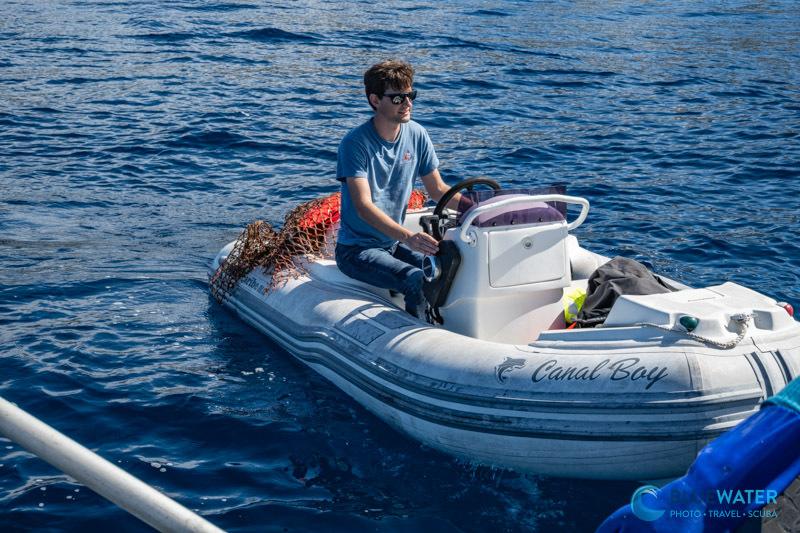
Curtis brings nets back to our mothership - the Giant Stride
I was taken aback by just how huge and heavy the mass truly was and started to understand the true scale of the operation. For once, I was witnessing a conversation with an immediate and direct impact on the marine environment. And not just any marine environment - the very same Southern Californian waters that the staff at Bluewater know, love, and dive.
This conservation effort was organized by the Southern California chapter of Ghost Diving USA - a non profit dedicated to removing derelict fishing gear and abandoned fishing nets, also known as ghost nets, that continue to fish after they are lost. I was lucky enough to have been invited by Ghost Diving USA to document the mission at the wreck of the Midnight Hour and was informed that I was first non-technical diver allowed in the water during such an operation. Bluewater has supported Ghost Diving USA as a local non profit for years. I felt privelaged to witness the work firsthand and to share their efforts with our community of divers and photographers who will hopefully support Ghost Diving as well (by clicking this link!).
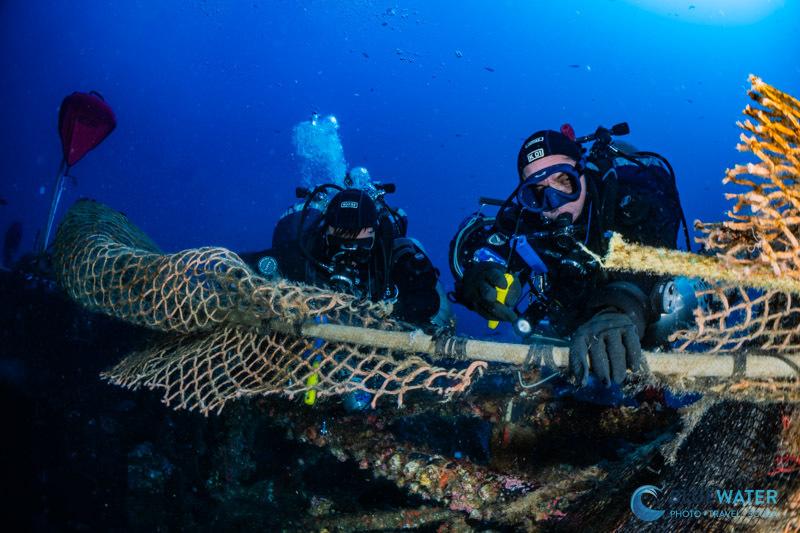
Juan and Norbert cut the net into manageable chunks for delivery 100 ft above
By the end of the day, the team had removed approximately 500 pounds of net from the Midnight Hour. It required technical divers, rebreathers, scooters, lift bags, a dedicated support vessel, a separate dinghy, surface support, a pulley system and a lot of physical effort. I expected a difficult dive and some underwater cleanup work. This was closer to a full-scale salvage operation.
And even after the net was out of the water, the work was nowhere close to finished.
Diving the Midnight Hour
The Midnight Hour is a 61-foot commercial purse seiner that sank off the west end of Catalina Island in 2011. It now rests on its starboard side in about 100 feet of water, along with what seems like a nearly impossible amount of its original fishing net.
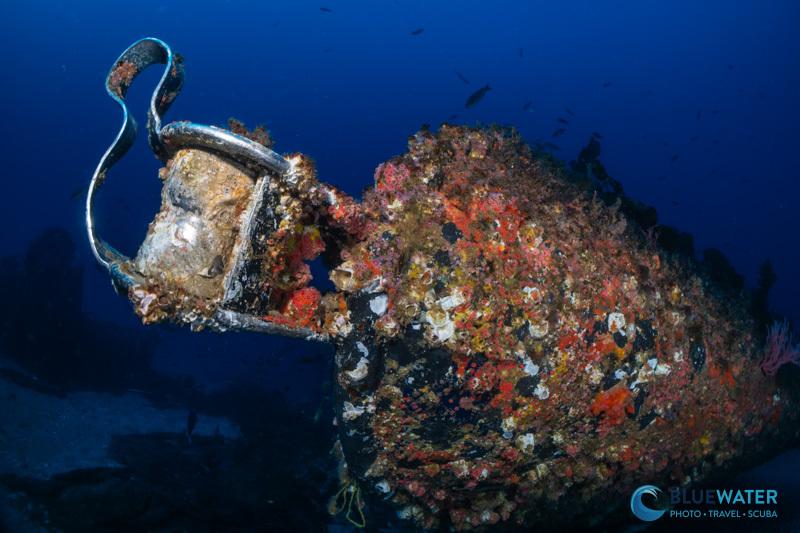
The colorful bow of the Midnight Hour
In the years since it sank, the wreck has turned into a productive artificial reef. Kelp grows from the structure and fish move in and out of the wreck for shelter. Anemones, whelks and other invertebrates cover almost every available surface. But the net is still doing what it was built to do - fishing.
Large sections have unrolled and draped themselves over the wreck, with some pieces extending well above it and others disappearing into deeper water. It was difficult to tell how much was actually there until we descended. From some angles, the net seemed to cover nearly the entire vessel.
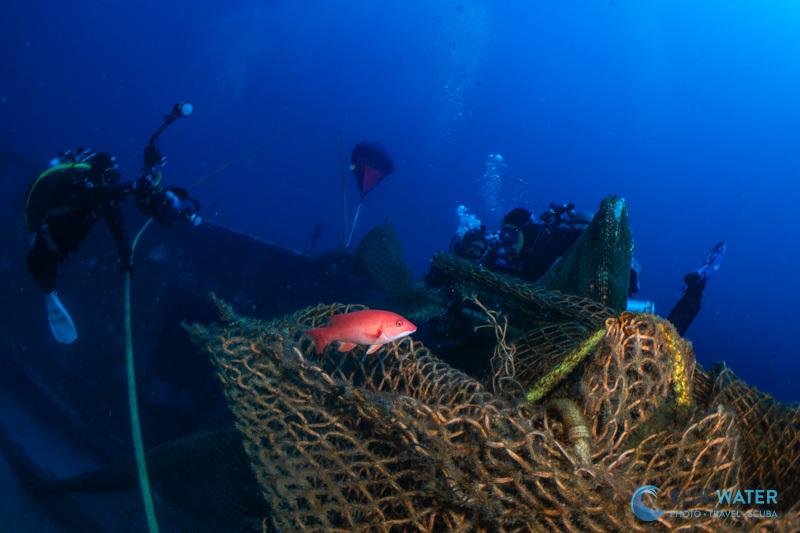
A female sheephead looks for protection amongst the net....not realizing that it could lead to her death
Some of it had been underwater long enough to become covered in marine growth, but animals were still being caught. We saw dead fish and invertebrates in the net, including recently deceased California sheephead. Sheephead are some of the more curious and friendly fish we encounter while diving in Southern California, which made seeing them tangled in the gear particularly sad.
The net recovery effort was led by Jim Babor, who planned the dive and coordinated the logistics both underwater and at the surface. The technical team included Norbert Lee, Juan Torres, and Nir Maimon. Norbert also works as a marine biologist with the City of Los Angeles and was there to document the fish and invertebrate mortality caused by the ghost net. Daniel Pio joined me as my recreational dive buddy while I photographed the wreck and the recovery with a Nikon Z8 and the new Sea & Sea YS-D130R strobes.
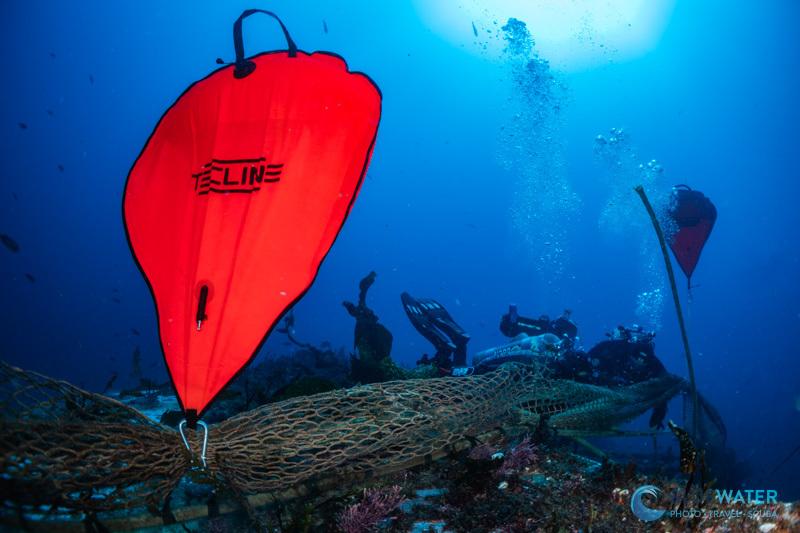
A section of the ghost net is almost ready for release with a lift bag
Jim’s briefing focused heavily on depth, bottom time, turnaround points, team positioning and the safe use of the lift bags. The biggest hazard was the net itself. It could snag a diver, wrap around equipment or shift without warning once a supporting section was cut. A freed section could also collapse onto the divers underneath it. Everyone needed room to work, and photographers especially needed to avoid crowding the teams cutting the net.
Underwater we had close to 100 feet of visibility, with clear blue Pacific water that flowed around the western end of Catalina. Unfortunately, the same water movement created a stiff current.
Daniel and I dropped quickly onto the wreck and I almost immediately developed a headache and mild narcosis from the high partial pressure of nitrogen. We spent most of the dive kicking into the current just to stay in position. Taking photos was difficult enough. The technical team had to remain steady while cutting through thick commercial net, rigging lift bags and managing their gas at more than 100 feet.
The water was around 60 degrees, which felt relatively comfortable to me, though probably not to everyone spending close to an hour and a half underwater.
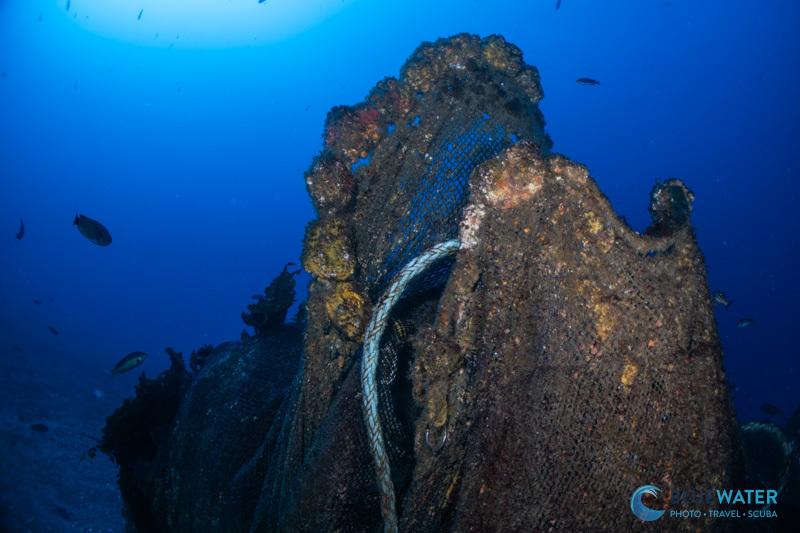
The net draped itself almost completely over large sections of the ship
The net was also much tougher than I expected. It was a heavy purse seine material that took specialized knives and a surprising amount of force to get through the mesh and thicker rope sections.
Some of the net extended deeper than the team anticipated. That created problems for the open-circuit divers using nitrox, who could not simply follow it deeper without considering their gas plan and oxygen toxicity. Jim and Nir, both on rebreathers, were able to reach some of these lower sections and cut them away. With heavy scooters and bailout bottles - the rebreather team carried almost 300 pounds of equipment!
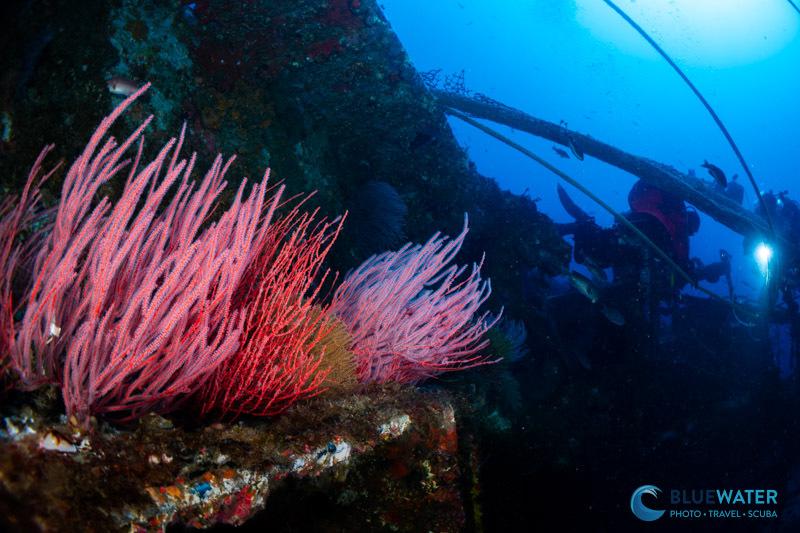
Beautiful gorgonians adorn the midnight hour
The divers divided the wreck into working areas and removed the net one section at a time. Once a piece was free, they attached lift bags and sent it toward the surface. Daniel and I returned to the boat before the technical team and were already back aboard when the first red bags began appearing through the fog.
Recovering the Net
At first, the lift bags looked fairly small from the boat. That changed as soon as Curtis reached them in the dinghy and we saw the masses hanging below the surface.
Curtis collected each section before the current could carry it away and brought it back toward the Giant Stride. Jim and Daniel helped transfer the net from the dinghy to the stern while the technical divers were still completing their dive.
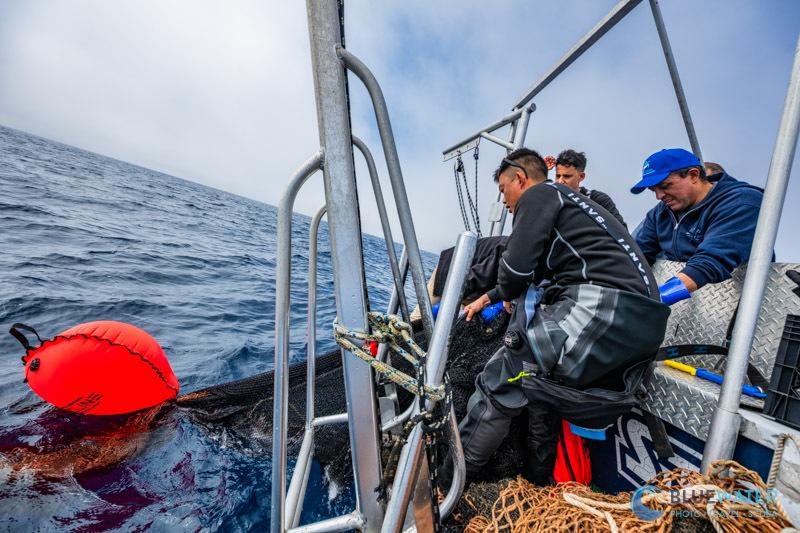
A manual pulley system is just enough to get the net onboard
The team had already expected to remove a lot of net, but there was considerably more on the wreck than anticipated.
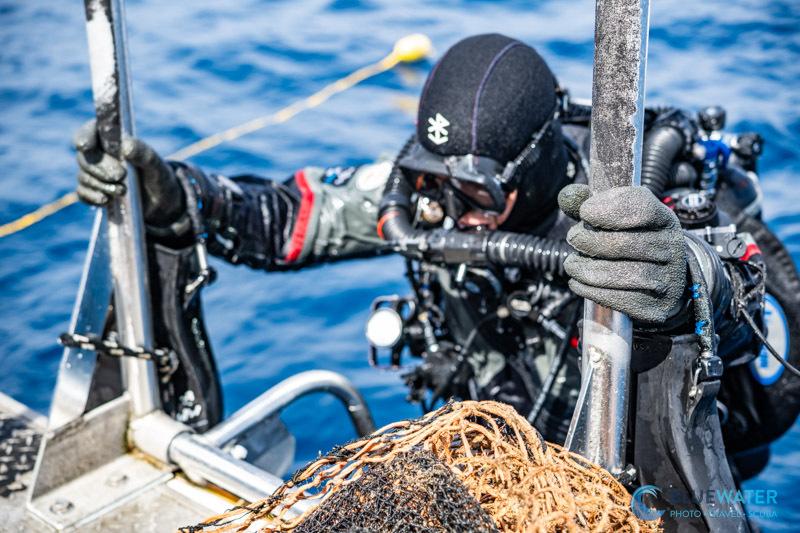
The largest section was enormous. Around five of us worked to haul it aboard using a basic pulley system. We pulled for a while, rested, changed positions and started again. The net caught on the stern and folded over itself as it came up, making it even more difficult to move.
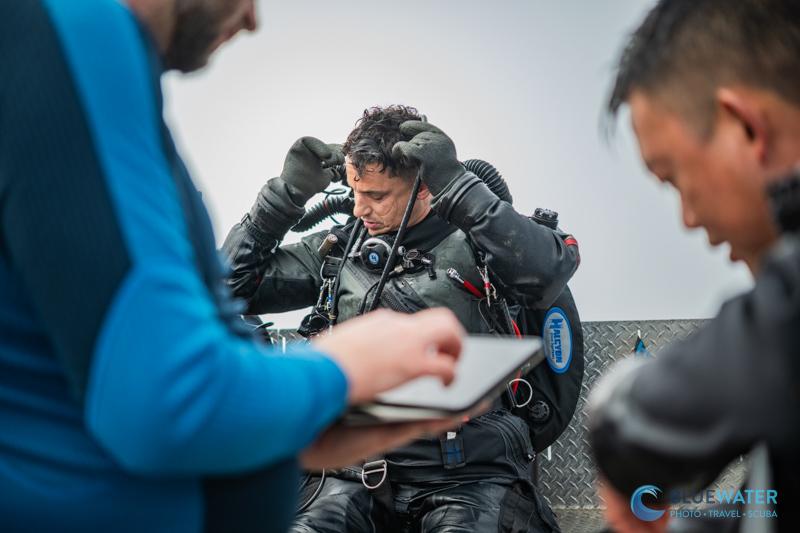
Norbert and Daniel record marine life destroyed by the ghost net while Nir gets out of his rebreather to help pull in the net
Earlier in my career, I worked as a fisheries observer aboard commercial vessels in the Bering Sea and Gulf of Alaska. When the first section came out of the water, I immediately recognized the sweet, earthy smell of wet fishing net. Even after sitting on the Midnight Hour for years, it smelled exactly the same.
The experience reminded me of how this gear would normally be handled. On a commercial vessel, we would have used a hydraulic winch or crane. On the Giant Stride, we had a pulley and however many people could find a place to pull.
By the time the technical divers returned, the stern was already filling with net. They had spent close to an hour and a half working at depth, but there was still plenty of physical work left to do at the surface.
By the end of the recovery, approximately 500 pounds of net had been removed from the wreck.
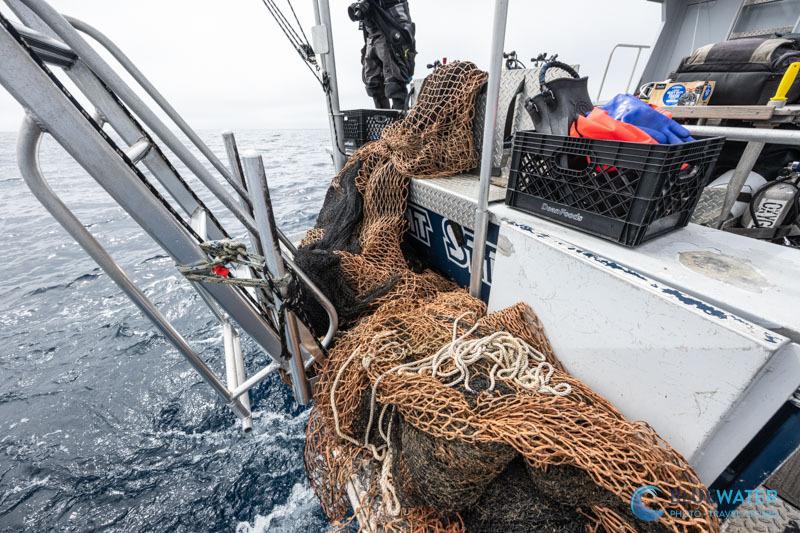 The net is heavier than it looks!
Back at the Dock
Getting the net onto the boat was not the end of the operation. When we returned to the dock, we unloaded it, stretched it out and began cutting it into pieces small enough to handle and transport.
It was just as difficult to cut above water as it had been below. The net was thick, dirty and tangled around itself, with heavy rope running through sections of it. Everyone continued working long after the dive was over.
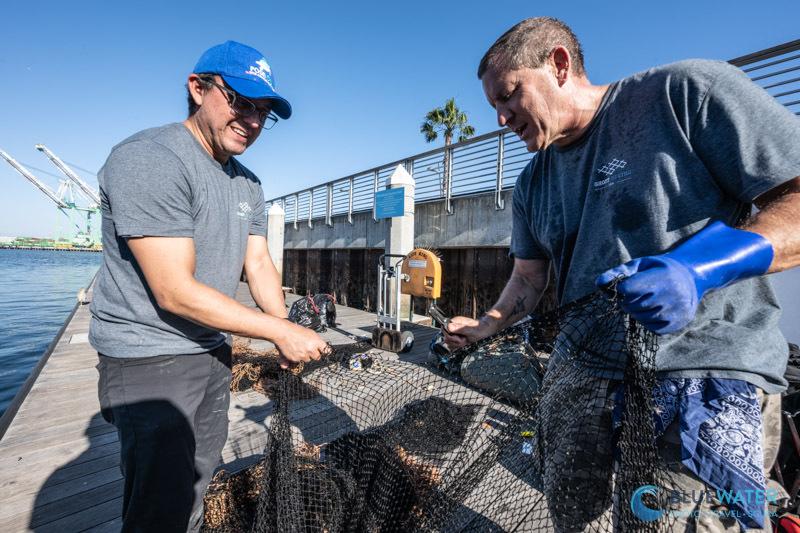
Cutting the net for recycling
This was the part of the mission that gave me a better understanding of what a ghost-net recovery actually involves. The diving is only one part. A team still has to track the lift bags, retrieve the net, tow it to the main boat, pull it aboard, unload it, cut it apart and arrange for it to be transported and recycled.
Jim ultimately took responsibility for getting the net to the recycler.
What impressed me most was the amount of expertise and physical effort involved in removing one net from one wreck. The divers were working at 100 to 110 feet in current, surrounded by material that could easily entangle them. They needed technical equipment, a detailed gas and decompression plan, scooters, rebreathers, lift bags and a capable surface team.
Then, after all of that, they still needed enough energy to haul the net onto the boat and spend hours cutting it apart.
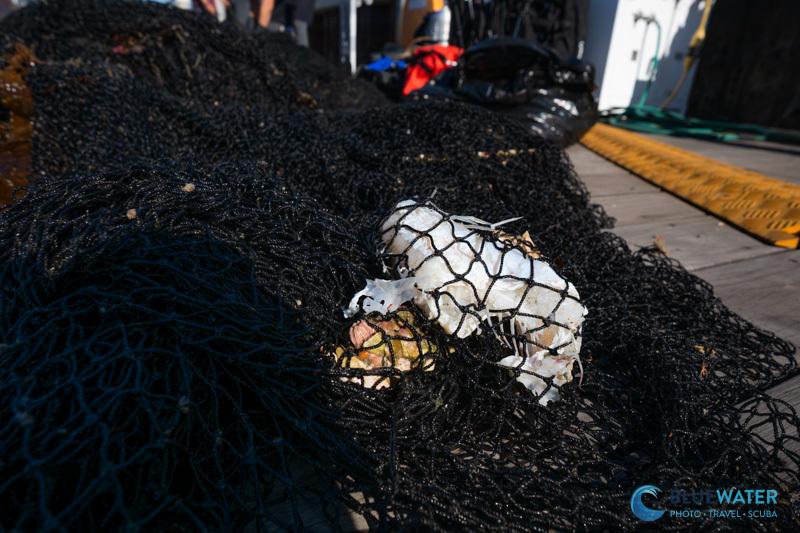
A victim of the ghost net
Bluewater has supported Ghost Diving USA for years, but seeing the operation firsthand gave me a much clearer idea of where that support goes. Boat time, fuel, breathing gases, equipment, recycling and logistics all cost money. More importantly, the work requires a dedicated group of divers with the training to do it safely.
At the beginning of the day, hundreds of pounds of net were still covering the Midnight Hour and continuing to trap marine life. By the time we finished, that net was spread across the dock and being prepared for recycling.
There are many ways to support ocean conservation, but it is difficult to imagine a result more direct than that. Click here to support Ghost Diving USA!
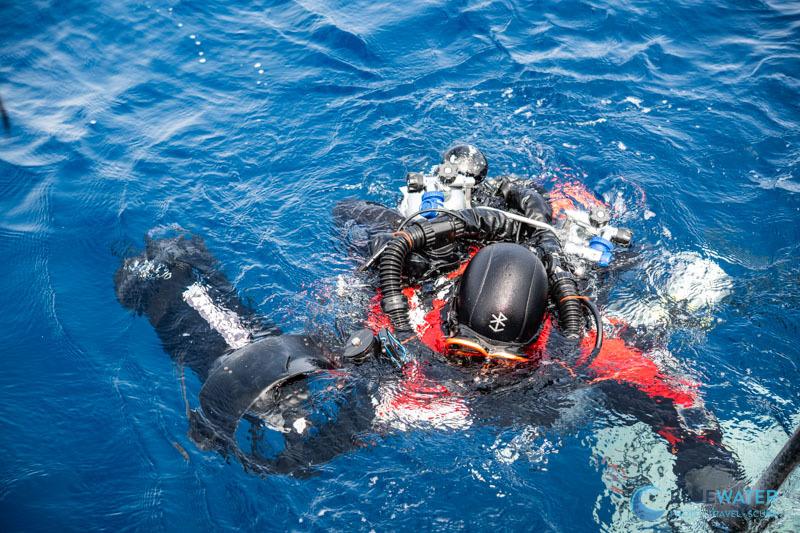
All this gear requires the utmost level of experience and effort!
Nirupam Nigam
Nirupam Nigam, the President of Bluewater Photo & Scuba, is an accomplished underwater photographer and fisheries scientist with a deep-rooted passion for marine life. He began his journey in underwater photography at 15 and, by age 22, became the Editor-in-Chief of uwphotographyguide.com, the leading online resource for underwater photographers. As a North Pacific and West Coast Fisheries Observer, Nirupam spends months aboard fishing vessels in remote areas such as the Bering Sea and Gulf of Alaska, collecting critical fisheries data for the U.S. government. He hails from the West Coast, considering both Southern California and Western Washington home.